I read this article, which resonated with me, especially since the World Cup of soccer is being held in the USA. The original article inspired me to think about a bigger question: what happens when elite training, recovery science, and regenerative medicine all line up to rewrite the limits of athletic aging?
Especially since the Elite soccer players like Lionel Messi and Cristiano Ronaldo are redefining athletic aging by competing at the highest level into their late 30s and early 40s. Their longevity reflects a dynamic interplay between advanced training science, meticulous lifestyle management, and increasingly sophisticated regenerative medicine.
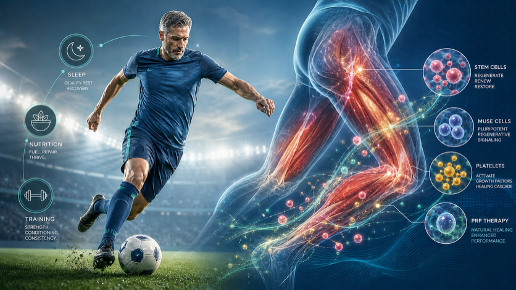
Contemporary sports performance programs place heavy emphasis on preserving tissue elasticity and resilience as athletes age, recognizing that muscles and tendons naturally stiffen over time and become more vulnerable to strain, rupture, and chronic tendinopathy. Strength and conditioning protocols are now highly individualized and position-specific: goalkeepers, who repeatedly hit the ground with high-impact dives, are conditioned differently from outfield players who accumulate large running loads and are prone to hamstring, adductor, and other lower-extremity injuries. This individualized work focuses not only on maximal strength but also on mobility, neuromuscular control, and the capacity to tolerate sustained physical and psychological stress across an entire competitive year, with periodized training cycles designed around long-term performance rather than short bursts of fitness.
Lifestyle and recovery are treated as core performance technologies in their own right. Sleep optimization, planned rest, and structured recovery days are central elements of elite athletes’ programs, and top players benefit from a multidisciplinary ecosystem of nutritionists, sports physicians, strength coaches, and psychologists whose entire mandate is to keep them healthy and available. Fueling strategies are highly precise and personalized to minimize systemic inflammation, support mitochondrial efficiency, and accelerate post-match recovery. This allows older players to maintain training volume and intensity that would likely have been unsustainable a generation ago. At the same time, experience and game intelligence play a quiet but critical role: players like Messi and Ronaldo have learned to “play smarter,”optimizing positioning, pacing, and decision-making in ways that reduce unnecessary high-risk sprints or collisions, thereby decreasing mechanical load on aging tissues without sacrificing effectiveness on the pitch.
Layered onto these advances in training and recovery is the rapidly growing influence of regenerative medicine, which is changing the trajectory of injury and degenerative change in high-level sport. Orthobiologic interventions such as platelet-rich plasma (PRP), bone marrow aspirate concentrates, and mesenchymal stromal cell–based therapies, and last but not least, MUSE cells are increasingly used to treat muscle tears, chronic tendinopathies, focal cartilage lesions, and early osteoarthritic changes that historically shortened careers or forced players into compensatory movement patterns. These therapies aim to enhance intrinsic healing by concentrating growth factors, modulating local inflammation, promoting more organized collagen and matrix remodeling, and potentially improving the biological quality of repaired tissue compared with standard conservative care alone. For an older player, the key advantage is not merely faster return to play from a single injury, but a reduction in the cumulative scarring and biomechanical compromise that tend to accumulate over years of repetitive damage. By improving tissue quality and dampening chronic low-grade inflammation, regenerative strategies support the same tissue resilience and elasticity that performance specialists are trying to preserve through tailored strength and mobility work.
In practice, this means that injuries which once would have been career-altering—recurrent hamstring tears, stubborn adductor tendinopathy, early chondral wear in the knee or ankle—can more often be managed without major surgery and with a higher likelihood of returning to preinjury performance levels in a shorter time frame. Over a decade, the result is fewer operations, less structural degradation, and a greater capacity to maintain high-intensity training loads into the late 30s and early 40s. Importantly, these medical interventions are embedded within carefully controlled recovery protocols, not used as stand-alone “fixes”: biologic injections are timed around deload phases, followed by progressive reloading, neuromuscular retraining, and reintegration into full match play. As the evidence base for various regenerative modalities continues to evolve, regulatory bodies and anti-doping agencies continue to scrutinize their use, but many of the core techniques, particularly PRP and certain cell-based approaches, have become accepted and relatively common in elite sport settings.
When you put all of this together optimized training, sophisticated recovery and nutrition, regenerative biologics that enhance healing and slow degeneration, and the accumulated skill and tactical intelligence of veteran players you arrive at the modern phenomenon of “older” footballers who can not only still compete at the World Cup but meaningfully shape the tournament well beyond what used to be considered an athlete’s prime. Below is the article for those who wish to read it. Dr. Purita