Every day, I hear people say the same thing:
“I’m just getting older.”
They say it when climbing stairs becomes difficult. When they feel tired after a short walk. When they notice they’re weaker than they used to be, gaining weight more easily, or struggling to recover from exercise.
While aging certainly changes our bodies, it’s often not the whole story.
In many cases, what we blame on aging is actually the cumulative effect of years spent moving less, losing muscle, sleeping poorly, eating inadequately, and allowing our fitness to gradually decline.
The greatest threat to healthy aging isn’t simply growing older.
It’s quietly abandoning the habits that keep us healthy.
Aging Is More Modifiable Than Most People Think
One of the most remarkable features of the human body is its ability to adapt throughout life.
Muscle can still be built in people well into their seventies and eighties.
Cardiovascular fitness can improve at almost any age.
Bone becomes stronger when it’s challenged.
Balance can be retrained.
Even the brain remains capable of forming new neural connections through physical activity, learning, and meaningful social engagement.
We cannot stop the passage of time, but we have tremendous influence over how well our bodies function as we age. That is an empowering message.
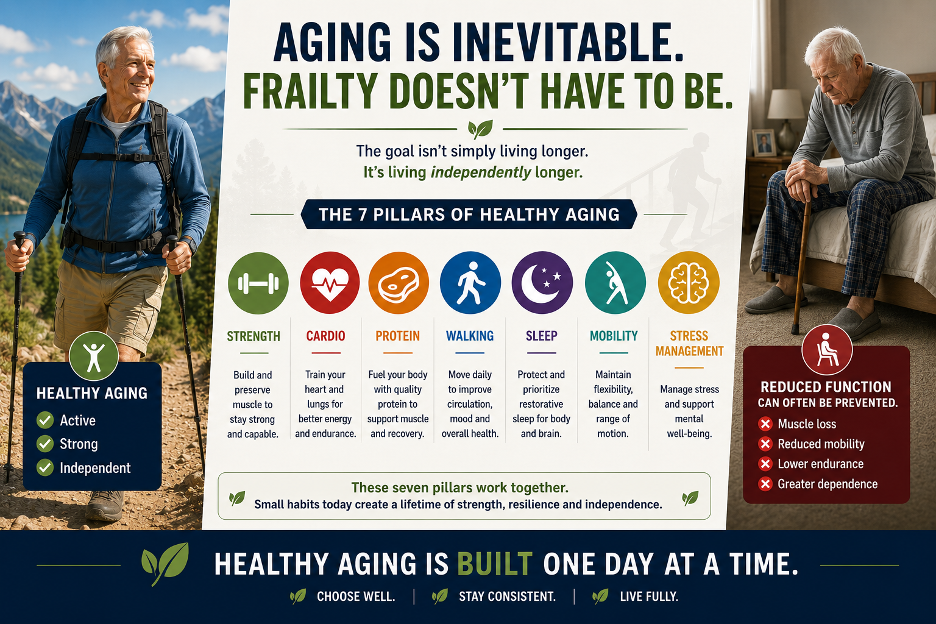
The goal isn’t simply to live longer.
It’s to remain healthy enough to enjoy the extra years you’ve earned.
What Does Healthy Aging Really Mean?
Healthy aging isn’t about looking younger.
It’s about maintaining the ability to live life on your own terms. Can you carry your groceries without assistance? Can you climb a flight of stairs without stopping? Can you travel comfortably? Can you play with your grandchildren? Can you get off the floor without needing help? Those everyday abilities, not the number on your birthday cake, are the true measures of successful aging. Unfortunately, many people begin losing these abilities decades before they realize what’s happening. Small declines in strength, endurance, and mobility often begin in our forties, accelerate through our fifties, and become increasingly noticeable during our sixties.
The good news is that much of this trajectory can be changed.
Seven Habits That Shape Healthy Aging
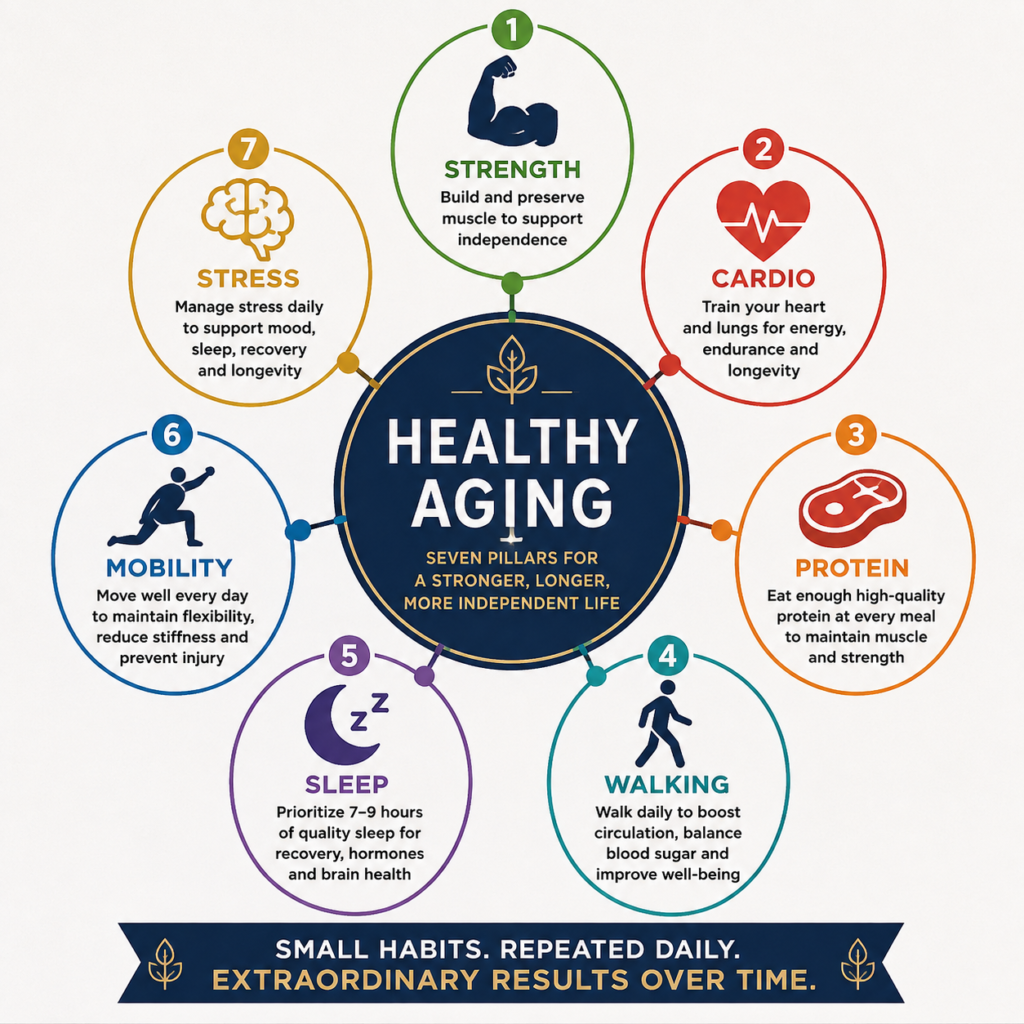
Healthy aging doesn’t require perfection. It requires consistency. These are the seven pillars I emphasize with patients who want to remain active, independent, and healthy for as long as possible.
1. Build and Preserve Muscle
If I could recommend only one form of exercise for healthy aging, it would be strength training. Aim for two to four full-body resistance-training sessions each week using fundamental movement patterns such as squatting, hinging, pushing, pulling, and carrying.
Muscle is much more than something we see in the mirror. It regulates metabolism, improves insulin sensitivity, strengthens bones, supports healthy joints, protects against falls, and allows us to perform everyday tasks with confidence. As we age, muscle naturally declines unless we challenge it. Fortunately, the body continues responding to resistance training throughout life. Every workout is an investment in future independence.
2. Train Your Heart
Strength and cardiovascular fitness go hand in hand.
A healthy heart allows us to remain energetic, recover more quickly, and continue enjoying an active lifestyle. Cardiorespiratory fitness is one of the strongest predictors of both longevity and healthspan. One excellent strategy is high-intensity interval training performed once each week. A simple example is the Norwegian 4×4 protocol: four minutes of challenging exercise followed by three minutes of easier recovery, repeated four times. Combined with regular moderate aerobic activity, interval training improves endurance, supports brain health, enhances metabolic function, and helps preserve cardiovascular health as we age.
3. Prioritize Protein
Exercise builds muscle only when the body has the raw materials needed for repair. That’s where protein becomes essential. Aim to include a palm-sized serving of high-quality protein with every meal. Fish, eggs, lean meats, Greek yogurt, cottage cheese, legumes, and whey protein are all excellent options. As we get older, our muscles become less responsive to protein, making adequate intake even more important. Without sufficient protein, preserving strength becomes much more difficult, regardless of how much you exercise.
4. Walk Every Day
Walking may be the simplest longevity habit available. It requires no special equipment, carries minimal risk, and provides enormous health benefits. Aim for approximately 8,000 steps each day. That goal can be achieved through intentional walks, walking meetings, taking the stairs, parking farther away, or simply moving more throughout the day. Regular walking improves circulation, supports healthy blood sugar, reduces inflammation, maintains joint mobility, and contributes to overall physical and mental well-being. Sometimes the best exercise is simply the one you’ll continue doing for decades.
5. Protect Your Sleep
Sleep is when the body performs much of its maintenance and repair. Hormones rebalance. Muscles recover. The brain consolidates memories. Inflammation decreases. The immune system is restored. When sleep suffers, nearly every aspect of health suffers alongside it.
One simple strategy is the 3-2-1 rule:
- No food within three hours of bedtime.
- No significant fluid intake within two hours.
- One hour of winding down without work, emails, or stimulating screens.
Just as important is maintaining a consistent bedtime and wake-up time throughout the week. Quality sleep is one of the most powerful regenerative therapies available, and it’s completely free.
6. Maintain Mobility
Strength without mobility eventually limits function. Spending just five to ten minutes each day maintaining flexibility and joint motion can have profound long-term benefits. Simple movements such as cat-cow stretches, hip mobility drills, shoulder circles, and glute bridges help preserve range of motion, improve posture, reduce stiffness, and decrease injury risk. Small daily investments often produce extraordinary results over the course of decades.
7. Learn to Recover from Stress
Stress is an unavoidable part of life. Remaining in a constant state of stress is not. Chronic stress disrupts sleep, increases inflammation, impairs recovery, contributes to high blood pressure, affects metabolism, and accelerates many biological processes associated with aging. Take ten to fifteen minutes each day to intentionally calm your nervous system. Go for a walk. Practice deep breathing. Read. Journal. Pray. Meditate. Sit quietly without looking at your phone. Recovery isn’t a luxury. It’s a biological necessity.
Don’t Forget the Importance of Human Connection
One of the most overlooked contributors to healthy aging isn’t found in a gym or a nutrition plan. It’s relationships. Research consistently shows that people with strong social connections live longer, maintain better cognitive function, experience lower rates of depression, and report a higher quality of life. Stay connected with family. Cultivate friendships. Volunteer. Join a walking group, an exercise class, or a community organization. A healthy life is built not only on movement and nutrition but also on meaningful relationships.
A Lesson from Harrison Ford
If you want a powerful example of healthy aging, consider Harrison Ford. At 82, he continues to act in major films, fly airplanes, hike, exercise, and live an extraordinarily active life. Meanwhile, many people only a few years younger struggle with weakness, poor endurance, falls, and loss of independence. Harrison Ford hasn’t stopped aging. He has simply kept investing in the habits that preserve strength, mobility, and independence. While genetics undoubtedly play a role, his lifestyle shows what decades of consistency can accomplish.
Where Regenerative Medicine Fits In
As someone who has spent more than two decades practicing regenerative medicine, I am excited by the remarkable advances occurring in stem cell therapy, biologics, exosomes, peptides, PhotoBioModulation, and other emerging technologies. These innovations have tremendous potential to help people recover from injury, reduce pain, and extend healthspan.
However, none of them replace the fundamentals. In fact, these therapies are most effective when they are built upon a strong biological foundation. Exercise, nutrition, restorative sleep, stress management, and maintaining muscle create the internal environment that allows regenerative therapies to achieve their greatest potential. The future of healthy aging will not depend on choosing between lifestyle and regenerative medicine. It will come from combining both. Lifestyle builds the foundation. Regenerative medicine helps optimize it.
The Bottom Line
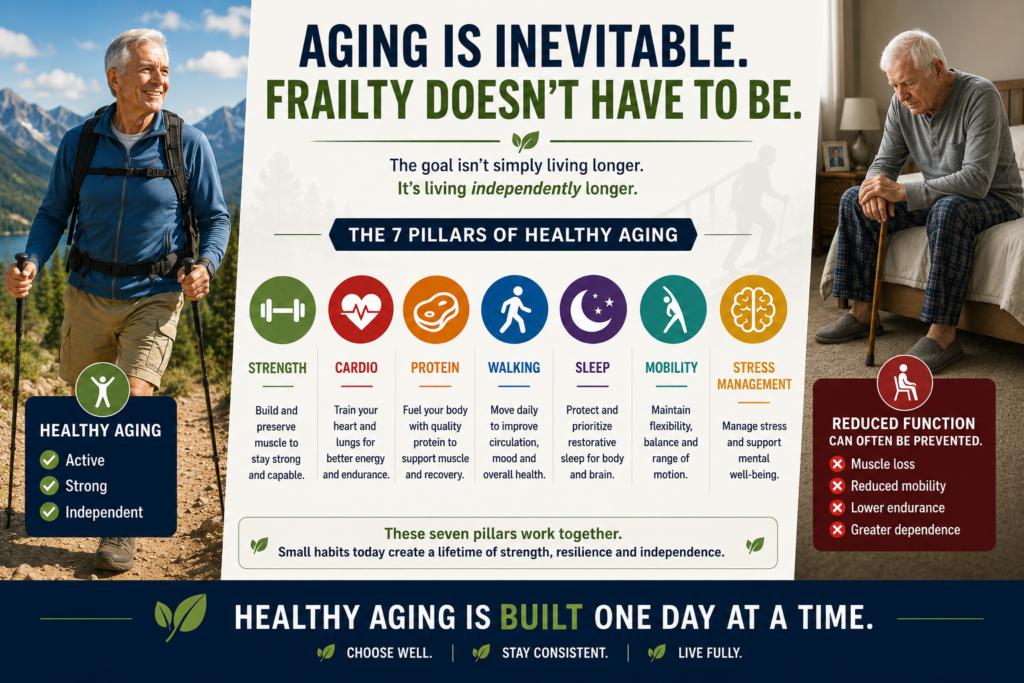
There is no single secret to aging well. There is no miracle supplement. No magic injection. No shortcut. Healthy aging is the result of thousands of small decisions repeated consistently over many years. Build muscle. Train your heart. Eat enough protein. Walk every day. Protect your sleep. Maintain your mobility. Manage your stress. Stay connected to the people who matter.
Those habits create the foundation for a longer, healthier, and more independent life. The choices you make in your forties and fifties become the life you experience in your seventies and eighties. You don’t have to become an action hero to age well. You simply have to keep giving your body reasons to remain strong, resilient, and capable. The best investment you can make in your future isn’t waiting for the next breakthrough in medicine. It’s building the habits that allow you to enjoy the breakthroughs that are already here. Dr. Purita
Your future health isn’t determined by one decision. It’s shaped by the choices you make every single day.