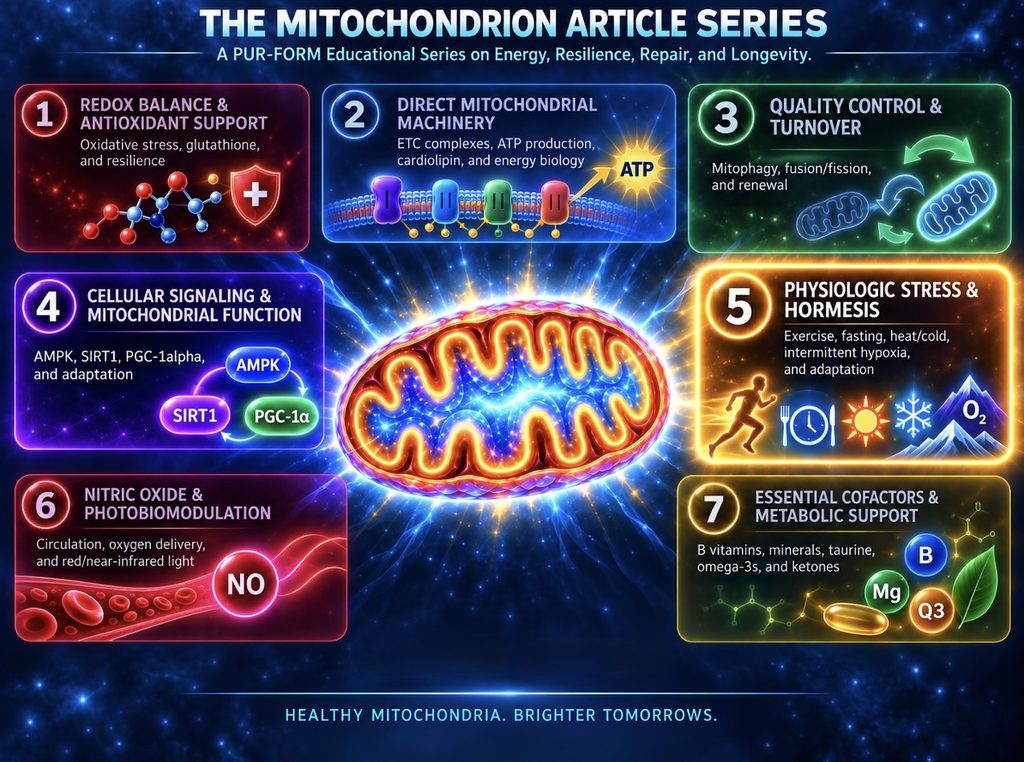
The Mitochondrion, Part 5: Physiologic Stress and Hormesis
Why the Right Dose of Stress Can Make Mitochondria More Resilient
A Series on Cellular Energy, Resilience, Repair, and Longevity
In Part Four of this series, we explored how cells sense changes in energy demand and metabolic conditions through signaling pathways such as AMPK, SIRT1, PGC-1alpha, and mTOR. But that raises another question: what actually generates the signal?
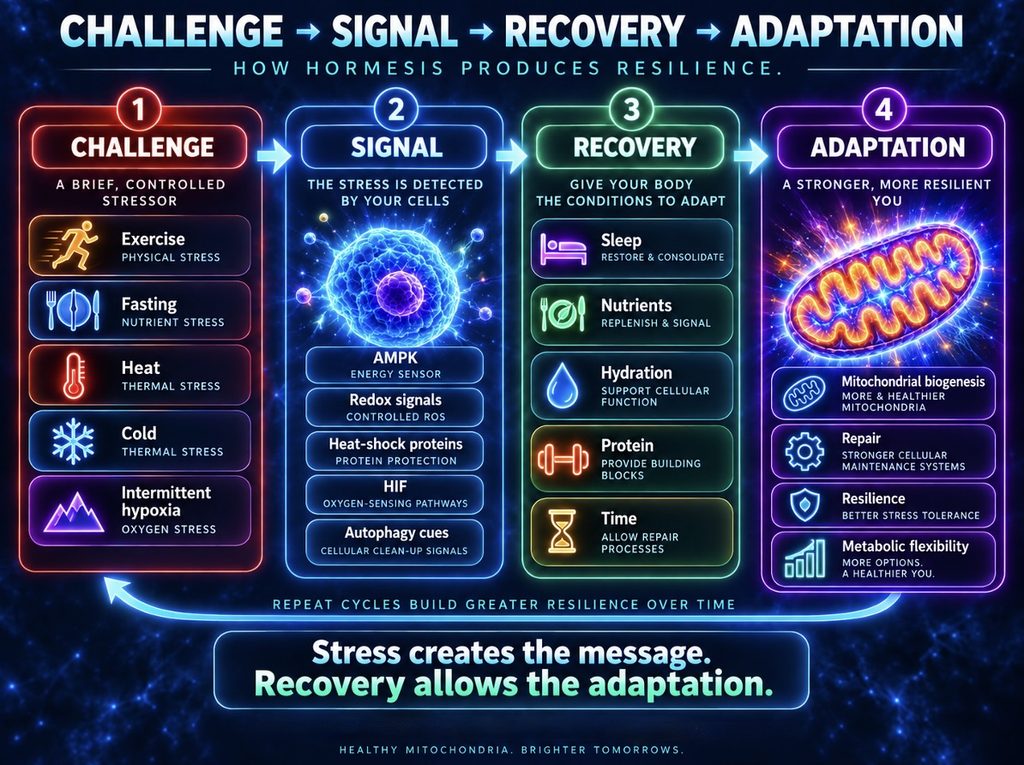
Very often, the answer is stress. Exercise temporarily increases energy demand. Fasting changes nutrient availability. Heat challenges temperature regulation. Cold forces the body to generate heat. Changes in oxygen availability activate oxygen-sensing pathways. Even a controlled oxidative challenge can create a transient biological signal.
At first glance, this may sound contradictory. We usually think of stress as harmful. But biology is more nuanced. A sufficiently intense or prolonged stress can injure cells, while a smaller, temporary, recoverable challenge may stimulate the body to adapt. This principle is known as hormesis.
Hormesis: When Stress Becomes Information
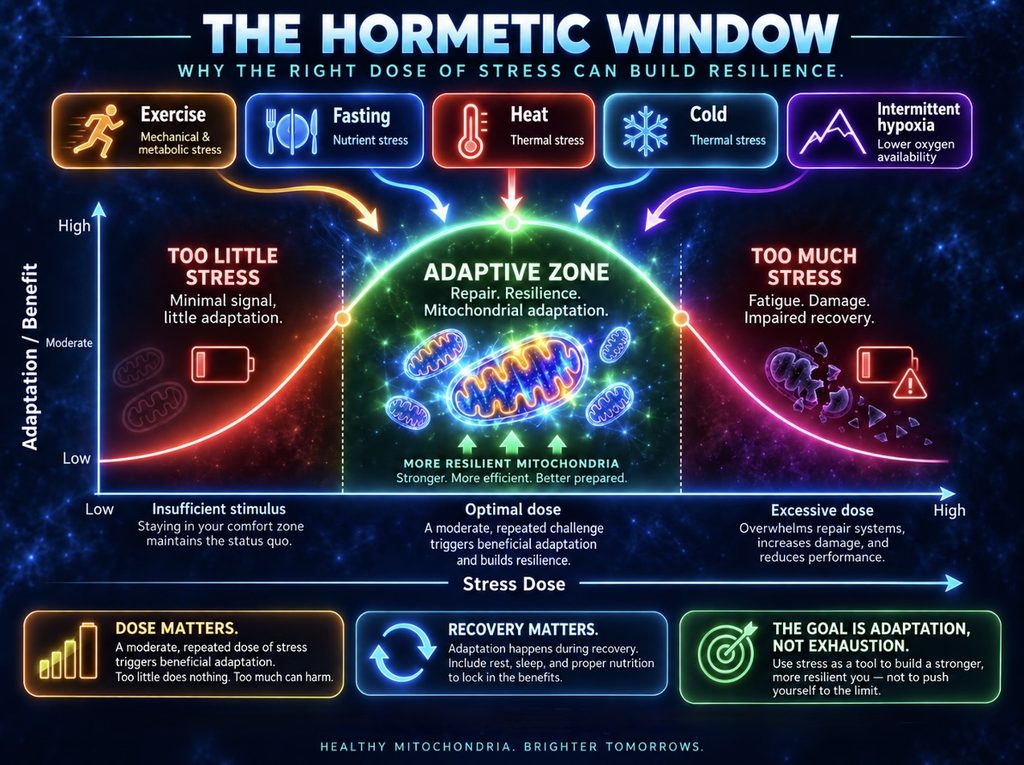
Hormesis describes a biological response in which the dose of a stressor matters. Too little challenge may produce little adaptation. An appropriate challenge can activate protective and repair pathways. Too much stress – or stress that continues without adequate recovery – can overwhelm those same systems and become harmful.
This creates what is often called a hormetic window. The key word is not simply stress but dose. Cells have evolved to respond to temporary changes in energy availability, temperature, oxygen, nutrient supply, mechanical demand, and redox state. When those changes remain within the body’s capacity to recover, they can activate pathways involved in antioxidant defense, mitochondrial biogenesis, autophagy, protein repair, and metabolic adaptation.
The goal of healthy biology is therefore not to create a completely stress-free system. A cell that is never challenged has little incentive to adapt.
Mitohormesis: Challenging the Mitochondria to Become More Resilient
When the adaptive response involves mitochondria, the concept is often called mitohormesis. Mitochondria sit at the intersection of energy production and stress signaling. When demand rises, ATP is consumed more rapidly, calcium signaling changes, electron flow shifts, and reactive oxygen species may temporarily increase.
If the challenge is manageable, these changes can signal rather than simply cause damage. A brief oxidative signal may help activate pathways that enhance antioxidant defenses, metabolic flexibility, and mitochondrial resilience. This brings us back to an important principle from Part One: oxidation is not inherently harmful.
The important questions are: How much? For how long? In what context? And with what recovery?
Exercise: Perhaps the Best Example of Hormesis
Exercise may be the most familiar and best-supported example of physiologic hormesis. During exercise, ATP demand rises sharply. Calcium levels fluctuate, and AMP and ADP increase relative to ATP. Mechanical stress is placed on muscle and connective tissue, and redox signaling changes.
In the short term, this is a challenge. Repeated appropriately, however, that challenge produces adaptation. Exercise stimulates signaling networks that enhance mitochondrial capacity, fuel utilization, oxidative metabolism, and stress resilience. The body does not improve because exercise eliminates stress. It improves partly because exercise creates a stress the body can successfully adapt to.
Adaptation doesn’t happen only during the workout. Exercise sends the signal; recovery is where much of the rebuilding occurs. Protein synthesis, glycogen restoration, mitochondrial remodeling, antioxidant adaptation, and tissue repair all depend on adequate recovery time, sleep, and nutrition.
Fasting: A Signal of Nutrient Scarcity
Fasting poses a distinct physiologic challenge. Rather than increasing energy demand, it temporarily reduces nutrient availability. Insulin signaling declines, fuel use shifts, fat oxidation and ketone production may increase, and pathways involving AMPK, sirtuins, mTOR, and autophagy can change.
The body receives a message: external fuel is temporarily limited, so adapt. This metabolic switching is one reason fasting and time-restricted eating have attracted interest for their effects on metabolic health and aging. But the hormetic principle still applies: a short fast and a prolonged fast are not the same intervention, and more is not automatically better.
Heat: Triggering a Protective Response
Heat provides another useful hormetic signal. When cells are exposed to elevated temperatures, proteins may begin to lose their normal structure. In response, cells activate protective pathways that include heat-shock proteins, molecular chaperones that help stabilize, refold, or remove damaged proteins.
Heat exposure also affects circulation, cardiovascular demand, and cellular stress signaling. The benefit does not come from simply overheating the body. It comes from a controlled thermal challenge that stays within the body’s ability to adapt and recover.
Cold: Forcing the Body to Generate Heat
Cold sends a different signal. When the body is exposed to a sufficiently cool environment, it must defend core temperature. Blood vessels constrict, shivering may occur, and brown adipose tissue can become more metabolically active.
Brown fat is particularly interesting from a mitochondrial perspective because it contains many mitochondria and can use stored energy to generate heat. Controlled cold exposure can therefore increase metabolic demand and stimulate adaptive responses. Extreme cold, however, is a very different physiologic challenge.
Oxygen Can Also Be a Hormetic Signal
Cells are highly sensitive to oxygen availability. When oxygen levels drop, signaling pathways can adjust metabolism, circulation, and gene expression. This is one reason carefully controlled intermittent hypoxic exposure has been investigated as a conditioning strategy.
But intermittent hypoxia also illustrates why hormesis must be discussed carefully. Too little oxygen for too long is clearly harmful. A brief, controlled reduction in oxygen is biologically distinct from the repetitive pathologic hypoxia seen in conditions such as untreated sleep apnea. Dose, duration, frequency, and patient context determine whether the stimulus is potentially adaptive or harmful.
EBO2: Can Controlled Oxidative Stress Become a Signal?
Another intervention that can be viewed through the lens of hormesis is EBO2, an extracorporeal blood oxygenation and ozonation treatment. Unlike exercise or fasting, EBO2 does not create its signal primarily through mechanical work or nutrient scarcity. It introduces a controlled oxidative challenge as blood circulates through an extracorporeal system.
Ozone is highly reactive and does not simply circulate through the body unchanged. When it interacts with blood components, it rapidly generates secondary reactive oxygen species and lipid oxidation products. At carefully controlled exposures, these molecules may function as redox signals rather than simply as sources of oxidative injury.
One pathway often discussed in the broader ozone literature is Nrf2, a major regulator of endogenous antioxidant defenses. Nrf2 signaling can increase expression of systems involved in glutathione metabolism, catalase, superoxide dismutase, heme oxygenase, and other cellular defense mechanisms. Conceptually, this makes EBO2 an interesting example of oxidative hormesis: a controlled oxidative challenge may signal the body to strengthen its own protective systems.
The distinction between biological rationale and clinical proof is important. The mechanistic concept is plausible, but direct evidence that EBO2 improves mitochondrial function or slows biological aging through this pathway remains limited. I therefore think it is more accurate to describe EBO2 as an emerging redox-conditioning strategy rather than a proven mitochondrial longevity therapy.
Hormesis Is Not the Same as Chronic Stress
This may be the most important distinction in the article. Hormetic stress is typically temporary, controlled, recoverable, and followed by adaptation. Chronic or excessive stress is different.
If a challenge is too intense, too frequent, or too prolonged, it can exceed adaptive capacity. Oxidative signaling can become oxidative damage. Exercise can become overtraining. Fasting can become undernutrition. Heat can become heat injury. Cold can become hypothermia. Hypoxia can become tissue oxygen deprivation. And an oxidative-conditioning strategy such as EBO2 ceases to be hormetic if the oxidative dose exceeds the body’s compensatory capacity.
Dose. Duration. Frequency. Baseline health. Recovery capacity.
The Recovery Phase May Be as Important as the Stress
The stress is only the first half of the process. The second half is recovery. A hormetic challenge tells the cell that conditions have changed, but adaptation requires adequate resources afterward: amino acids for protein repair, micronutrients for enzymatic function, sleep for neuroendocrine recovery, sufficient energy, healthy circulation, and functioning repair systems.
Challenge -> Signal -> Recovery -> Adaptation
That sequence is more useful than the idea that more challenge must produce more benefit. Without adequate recovery, repeated stress can exceed the system’s capacity to adapt.
Why Too Much Protection Can Also Be a Problem
Hormesis raises another interesting question. If some oxidative signaling is required for adaptation, what happens if we try to suppress every sign of cellular stress? Not every transient increase in reactive oxygen species should automatically be viewed as something that must be eliminated.
This does not mean oxidative damage is desirable. It means that the signal itself can sometimes be part of the adaptive response. In certain settings, excessive suppression of that signal may blunt some of the very pathways we are trying to stimulate.
How We Think About Hormesis
This concept fits naturally into the broader regenerative model. The goal is not simply to give the body more substances. It is also to create the right biological signals.
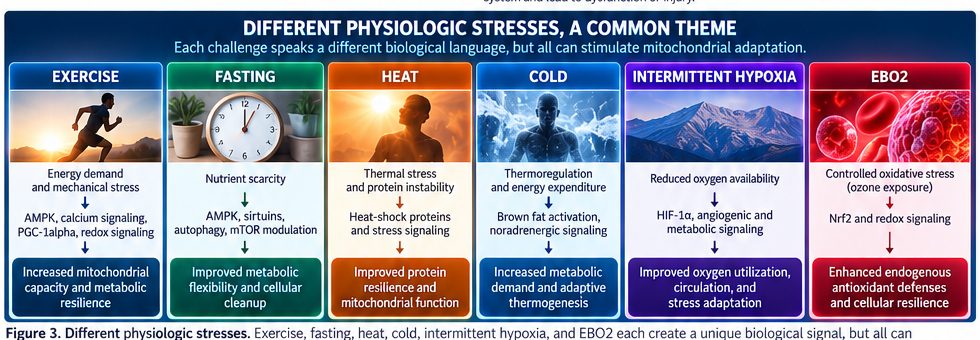
Exercise challenges energy production. Fasting challenges nutrient availability. Heat challenges thermal regulation and protein stability. Cold challenges thermoregulation and metabolic demand. Intermittent hypoxia challenges oxygen-sensing systems. EBO2 may challenge the redox system through a controlled oxidative signal.
Each speaks a different biological language, and each may activate different adaptive pathways. The objective is not to maximize any one stressor. It is to use physiologic challenges intelligently enough to stimulate adaptation without overwhelming the body’s ability to recover.
Stress is not automatically the enemy.
Uncontrolled stress can be harmful.
But the right challenge, delivered at the right dose, may be exactly what tells the body to become more resilient.
Next in the Series: Nitric Oxide and Photobiomodulation
Once we understand that mitochondria respond to their environment, two additional signals become especially interesting: nitric oxide and light.
In Part Six, we will explore how nitric oxide influences blood flow, oxygen delivery, mitochondrial respiration, and cellular signaling – and how red and near-infrared light may interact with mitochondrial biology through photobiomodulation.
Because mitochondria respond not only to nutrients and stress. They also respond to oxygen, circulation, and light.
Dr. Joseph Purita