
The Mitochondrion, Part 4: Cellular Signaling and Mitochondrial Function
How Cells Decide When to Produce Energy, Adapt, Build, and Repair
A Series on Cellular Energy and Healthy Aging
In Part Three of this series, we explored mitochondrial quality control—the systems that allow cells to repair, recycle, and renew their mitochondrial population. But that leads to another fundamental question: how does a cell know what its mitochondria should do next?
A muscle cell during exercise has very different needs from that same cell at rest. A cell after a meal receives different signals from one several hours into fasting. Sometimes the priority is energy production. At other times it may be growth, repair, fuel conservation, cellular cleanup, or the expansion of mitochondrial capacity.
Mitochondria do not make these decisions alone. They are part of a responsive communication network that continually senses energy availability, nutrients, hormones, oxygen, calcium, oxidative stress, and the overall condition of the cell. Those signals help determine how the mitochondrial system should respond.
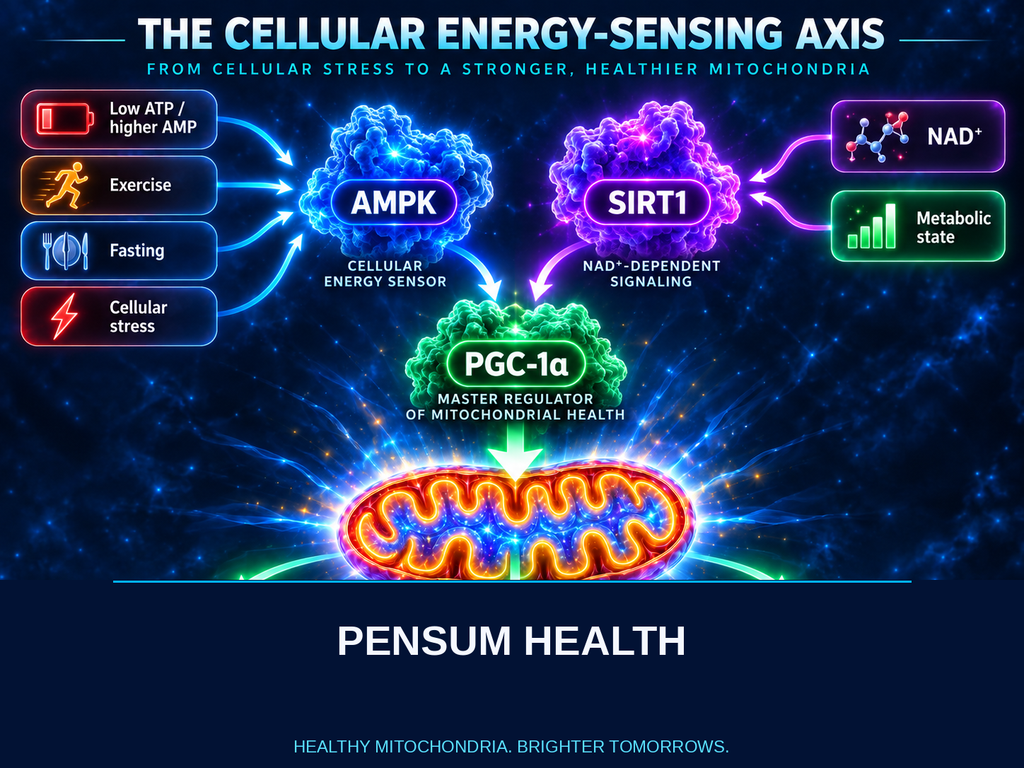
Three important players in this conversation are AMPK, SIRT1, and PGC-1alpha. They represent only part of a much larger network, but together they offer a useful way to understand how changing cellular conditions are translated into mitochondrial adaptation.
AMPK: The Cell’s Energy Gauge
AMPK stands for AMP-activated protein kinase. The name sounds complicated, but its basic role is straightforward: AMPK helps the cell recognize when available energy is becoming limited.
ATP is the cell’s primary energy currency. When energy is being used rapidly, ATP falls while lower-energy molecules such as ADP and AMP become relatively more abundant. AMPK responds to this changing energetic state and helps shift cellular priorities.
Think of AMPK as a cellular energy gauge. When energy is plentiful, the cell can devote more resources to growth, storage, and synthesis. When energy becomes limited or demand rises, AMPK helps favor processes that restore energy availability. Depending on the tissue and circumstances, this can include glucose uptake, fatty-acid oxidation, fuel mobilization, autophagy, and mitochondrial adaptation.
Energy demand is rising. Adjust the system.
AMPK can also influence PGC-1alpha, helping connect an immediate energy challenge with longer-term changes in mitochondrial capacity.
SIRT1: Connecting NAD+ Biology With Cellular Adaptation
A second important player is SIRT1, a member of the sirtuin family of enzymes. SIRT1 is particularly interesting because it requires NAD+ for its activity.
In Part Two, we discussed NAD+ as an important participant in metabolism and electron transfer. But NAD+ also serves as a substrate for signaling enzymes such as SIRT1. SIRT1 modifies proteins through a process called deacetylation, and one of the proteins it can regulate is PGC-1alpha.
AMPK and SIRT1 can also influence one another, linking cellular energy sensing with NAD-dependent signaling. This helps explain why NAD+ has attracted so much attention in longevity research—but it also explains why the biology cannot be reduced to “more NAD+ equals younger mitochondria.”
NAD biology varies by tissue, cellular compartment, metabolic state, and timing. Simply increasing NAD+ does not automatically recreate the complex signaling effects of exercise, fasting, or improved metabolic health. The mitochondrion operates within a network, not an on/off switch.
PGC-1alpha: Turning Signals Into a Mitochondrial Response
PGC-1alpha is a transcriptional coactivator. Rather than switching a single gene on or off, it works with other regulatory proteins to coordinate programs involved in mitochondrial metabolism, fatty-acid oxidation, antioxidant defense, and mitochondrial biogenesis.
A useful way to think about PGC-1alpha is as a conductor. AMPK and other pathways signal that conditions have changed. SIRT1 can modify PGC-1alpha in response to metabolic information. PGC-1alpha then helps coordinate a broader gene-expression response so mitochondrial function can adapt to what the cell is being asked to do.
This is why PGC-1alpha is often described as a major regulator of mitochondrial biogenesis. It is best understood not as a single master switch, but as a central coordinator within a much larger signaling network.
From a Signal to New Mitochondrial Capacity
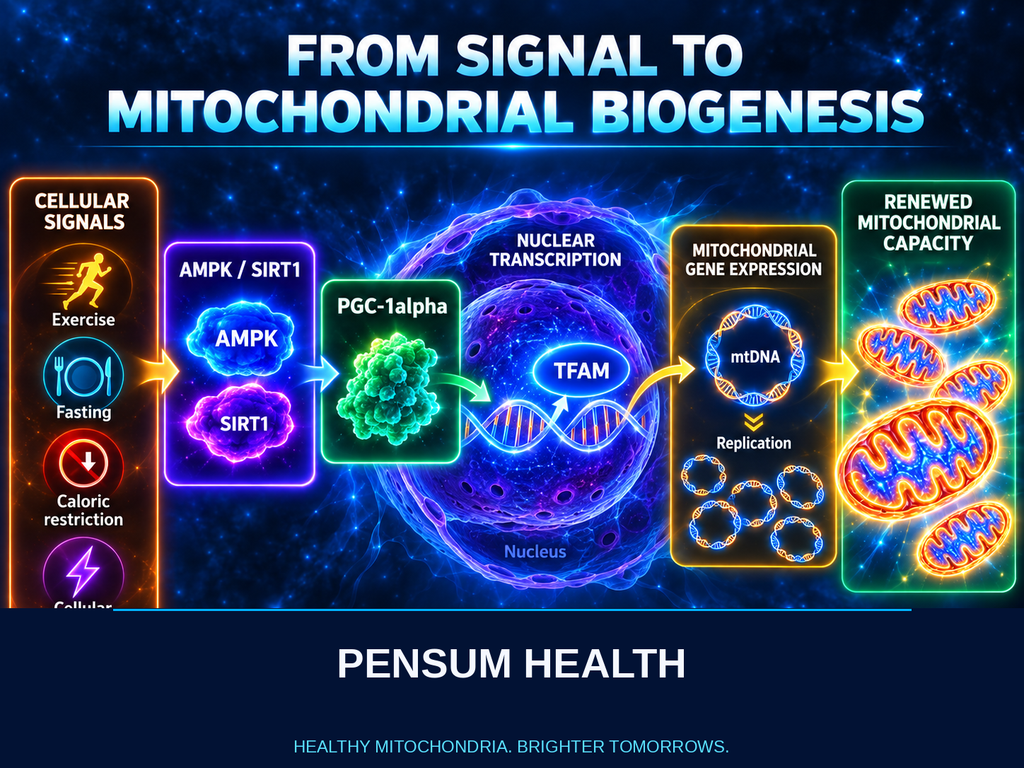
PGC-1alpha does not simply tell the cell to “make another mitochondrion.” The process is more sophisticated. It works with nuclear transcription factors to increase expression of genes needed for mitochondrial metabolism and function. One important downstream player is TFAM—mitochondrial transcription factor A.
This matters because mitochondria depend on two genetic systems. Most mitochondrial proteins are encoded by DNA in the cell nucleus, while mitochondria also contain a small amount of their own DNA, known as mitochondrial DNA or mtDNA.
TFAM helps regulate mitochondrial DNA transcription, replication, packaging, and maintenance. In this way, signals generated by changing energy demands can ultimately influence the machinery responsible for maintaining and expanding mitochondrial capacity.
This process is broadly called mitochondrial biogenesis. But Part Three taught us an important principle: more mitochondria are not automatically better mitochondria. Healthy mitochondrial biology requires coordination between new capacity and quality control. The real objective is renewal—maintaining an efficient mitochondrial population matched to the needs of the cell.
mTOR: The Other Side of the Metabolic Conversation
To understand AMPK properly, it helps to consider another major pathway: mTOR, particularly mTOR complex 1, or mTORC1. AMPK often becomes more prominent when energy is limited or demand is high, while mTORC1 responds strongly to signals associated with nutrient availability, amino acids, insulin, growth factors, and cellular growth.
When conditions are favorable, mTORC1 promotes processes such as protein synthesis and tissue building. This is sometimes oversimplified into the idea that AMPK is “good” and mTOR is “bad.” That is not how healthy biology works.
We need mTOR signaling to maintain muscle, synthesize proteins, repair tissue, and respond normally to nutrition. We also need periods in which cellular maintenance, autophagy, fuel mobilization, and stress adaptation receive greater priority.
There are times to build, times to repair, times to conserve, and times to recycle.
Metabolic Flexibility: Knowing When to Change Programs
The ability to move appropriately between these states is part of what we call metabolic flexibility. After a meal, the biological message is different from the message generated during fasting. A contracting muscle has different priorities from a resting muscle. A cell recovering from stress has different needs from one experiencing nutrient abundance.
AMPK, SIRT1, PGC-1alpha, mTOR, insulin signaling, calcium-sensitive pathways, hormones, and many other systems participate in this conversation. The goal is not for one pathway to dominate permanently. The goal is responsiveness: a healthy cell should be able to change its behavior when conditions change and then return toward balance when the challenge has passed.

Exercise: A Powerful Mitochondrial Signal
Exercise provides perhaps the clearest real-world example of these pathways working together. When muscle contracts, ATP demand rises, calcium signaling changes, AMP and ADP increase relative to ATP, and redox conditions shift. These changes tell the cell that its current energy system is being challenged.
In response, interconnected pathways involving AMPK, calcium-sensitive signals, PGC-1alpha, and other regulators can promote mitochondrial remodeling and adaptation. Repeated over time, this contributes to improved oxidative metabolism and mitochondrial capacity. Exercise is therefore more than a way to burn calories: it provides information and gives the cell a reason to adapt.
Fasting Sends a Different Message
Reduced nutrient availability creates another metabolic signal. During fasting or energy restriction, insulin and nutrient signaling change, fuel use shifts, and pathways involving AMPK, NAD metabolism, sirtuins, autophagy, and mTOR can also change.
But this concept should not be taken to an extreme. If some nutrient restriction can generate adaptive signals, it does not follow that progressively longer fasting must produce progressively greater benefit. Cells still require protein, essential fats, vitamins, minerals, and adequate energy to maintain tissue and recover.
As we have seen throughout this series, dose and context matter. The goal is not maximum stress. It is an appropriate challenge followed by an effective adaptive response.
Why Permanently Activating One Pathway Makes Little Sense
Once a pathway is associated with a beneficial response, there is a natural temptation to ask how we can keep it turned on. But signaling pathways evolved to change.
AMPK should become more active under some conditions and less active under others. mTOR should rise when protein synthesis, growth, and tissue repair are needed. SIRT1 operates within a larger NAD-dependent metabolic environment. PGC-1alpha should respond to genuine physiologic demand.
Healthy biology depends on cycling between states, not permanently locking the cell into one of them. The goal is not maximum pathway activation. It is appropriate activation at the appropriate time.
Can We Influence These Pathways?
Yes—but this is where scientific restraint matters. Exercise, sleep, nutrition, energy balance, metabolic health, and physiologic stress can all influence mitochondrial signaling. Nutritional compounds and pharmaceuticals are also being studied for their effects on AMPK, sirtuins, NAD metabolism, mTOR, and PGC-1alpha.
But showing that a compound activates AMPK in a laboratory experiment is not the same as showing that it improves human health. Increasing NAD+ does not necessarily reproduce exercise. Suppressing mTOR is not automatically desirable. And increasing PGC-1alpha signaling does not guarantee the same effect in every tissue.
A more useful question is not “How do we activate AMPK?” but “What signal does this cell need in order to restore appropriate metabolic function?”
Why This Matters as We Age
Aging is not simply a story of declining ATP production. It also involves changes in nutrient sensing, mitochondrial communication, quality control, and the ability of cells to adapt to physiologic stress.
The question may therefore be less about whether one pathway is “high” or “low” and more about whether the system remains responsive. Can the cell recognize rising energy demand? Can it mobilize fuel? Can it activate repair? Can it build additional mitochondrial capacity when needed—and return to growth and rebuilding when nutrients and recovery are available?
Healthy aging may depend in part on preserving the ability to move intelligently between these biological states.
How We Think About Mitochondrial Signaling
At Pensum Health, this is why I think mitochondrial health should be viewed as a dynamic biological system rather than a list of mitochondrial supplements. NAD-related strategies, CoQ10, exercise, nutrition, oxygen delivery, redox conditioning, metabolic therapies, and other interventions may all influence mitochondrial biology, but they act through different mechanisms and within different physiologic environments.
The goal is not to keep AMPK permanently activated. It is not to suppress mTOR indefinitely. And it is not simply to push NAD+ as high as possible. The goal is to preserve the cell’s ability to sense what is happening, generate the appropriate response, adapt to the challenge, and then return toward balance.
In simple terms: AMPK helps the cell recognize energy stress. SIRT1 connects NAD-dependent metabolism with cellular signaling. PGC-1alpha helps coordinate the mitochondrial response.
Together with mTOR and many other pathways, they help the cell answer one of biology’s most important questions: What should we do next?
Next in the Series: Physiologic Stress and Hormesis
Once we understand how cells recognize energy demand and metabolic stress, the next question becomes fascinating: can carefully controlled physiologic stress make this system more resilient?
In Part Five, we will explore physiologic stress and hormesis—including exercise, fasting, heat, cold, and other challenges that can stimulate adaptive mitochondrial responses.
The objective of healthy aging may not be to eliminate every biological stress. It may be to preserve the body’s ability to recognize stress, respond appropriately, recover, and become more resilient because of it.
Dr. Joseph Purita