
The Mitochondrion, Part 3: Quality Control and Turnover
How Cells Repair, Recycle, and Renew Their Mitochondria
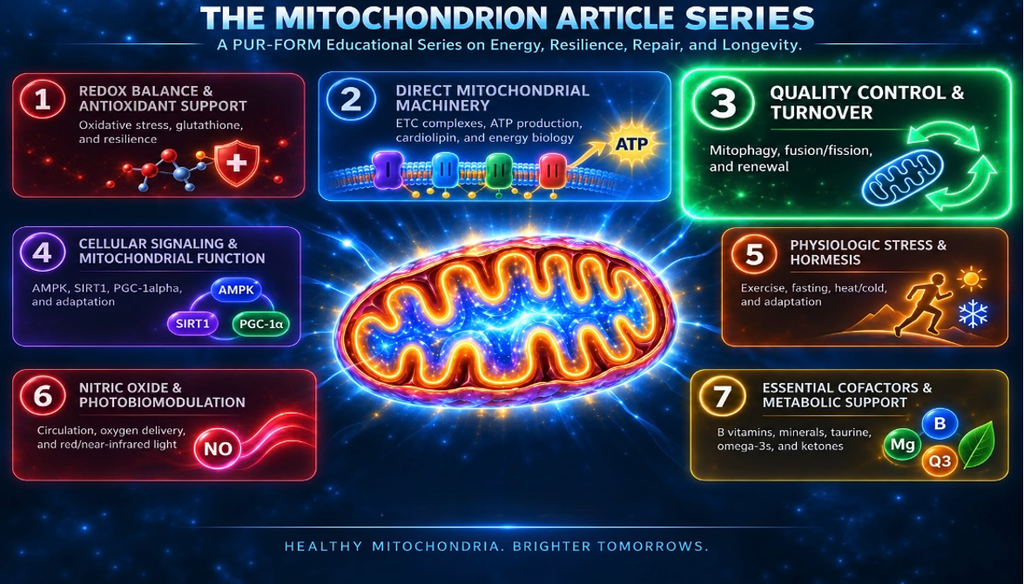
A Series on Cellular Energy and Healthy Aging
In Part Two of this series, we looked inside the mitochondrial engine and explored how cells convert fuel and oxygen into ATP, the usable energy that powers almost everything we do. But making energy is only half the story. The cell also has to maintain the machinery that makes that energy.
Mitochondria operate in a demanding environment. They move high-energy electrons, handle oxygen, respond to changing fuel availability, generate ATP, and participate in cellular signaling. Over time, proteins can become damaged, membranes can lose integrity, mitochondrial DNA can accumulate injury, and individual mitochondria can become less efficient.
The cell cannot simply allow worn-out mitochondria to accumulate. It needs a maintenance system that preserves what remains useful, isolates what is damaged, removes what no longer functions well, and renews mitochondrial capacity when needed. Together, these processes constitute mitochondrial quality control.
| Mitochondrial health is not just about making energy. It is about maintaining the quality of the mitochondria that make that energy. |
Mitochondria Are Constantly Changing
The mitochondrion shown in a textbook usually looks like a single bean-shaped structure. Inside a living cell, mitochondria are far more dynamic. They move, change shape, join together, divide, exchange material, and respond continuously to energy demand and cellular stress.
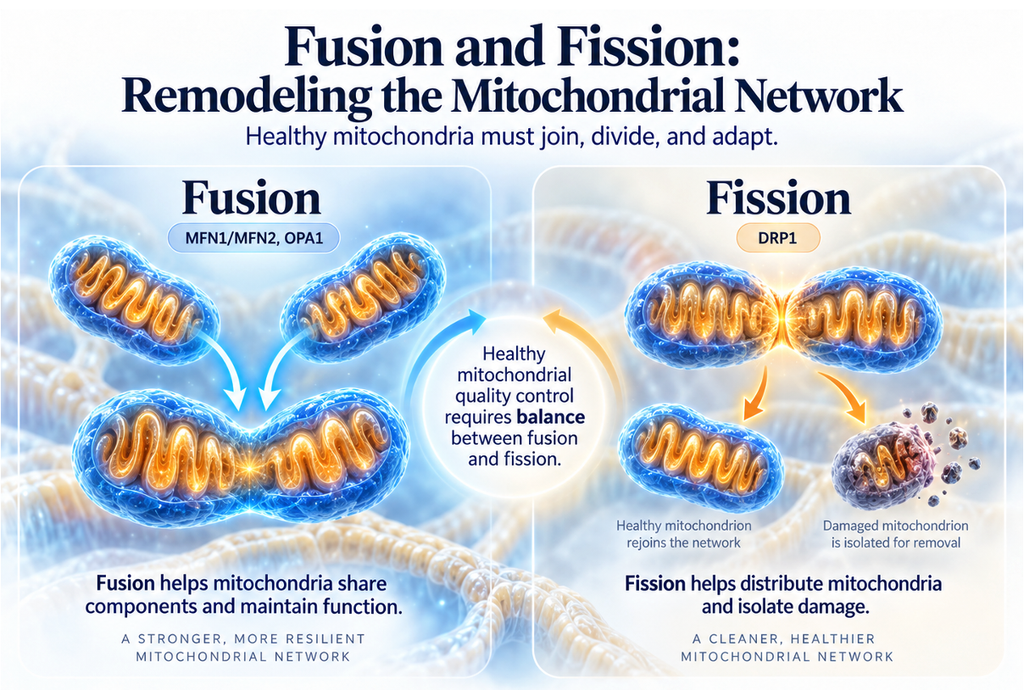
In many tissues, mitochondria behave less like isolated batteries and more like a living network that is constantly remodeled. Two processes drive that remodeling: fusion and fission. Fusion allows mitochondria to join together, and fission allows them to divide. Healthy cells need both.
Fusion: Sharing Resources and Maintaining Function
During mitochondrial fusion, two mitochondria join portions of their outer and inner membranes. Proteins such as MFN1, MFN2, and OPA1 coordinate this process. Fusion allows mitochondria to share proteins, lipids, metabolites, and other components, helping stabilize function across the network when one mitochondrion is temporarily stressed.
A useful way to think about fusion is as resource sharing and repair. But fusion cannot solve every problem. If part of a mitochondrion becomes too damaged, the cell may need to separate that portion from the healthier network.
Fission: Separating Damage
During mitochondrial fission, a mitochondrion divides into smaller units. A key protein involved is DRP1. Fission helps the mitochondrial network adapt to changing energy demands, distributes mitochondria during cell division, and can separate damaged regions from healthier ones.
Think of this as cellular triage. A partially dysfunctional mitochondrion doesn’t always have to be discarded entirely. Fission can help isolate the damaged portion while healthier mitochondrial material remains in the network. Once the cell separates the damage, it must decide whether to salvage the mitochondrion or remove it.
Mitophagy: Taking Damaged Mitochondria Out of Service
Most people have heard the term autophagy, the cellular process that breaks down and recycles damaged or unnecessary components. Mitophagy is a specialized form of autophagy directed specifically toward mitochondria.
Its purpose is straightforward: mitochondria that no longer function adequately should not remain in the cell indefinitely. A dysfunctional mitochondrion may produce energy inefficiently, lose membrane potential, disturb redox balance, or release signals that contribute to inflammation and cellular stress. Removing it is not simply housekeeping. It is quality control.
PINK1 and Parkin: Recognizing Mitochondrial Damage
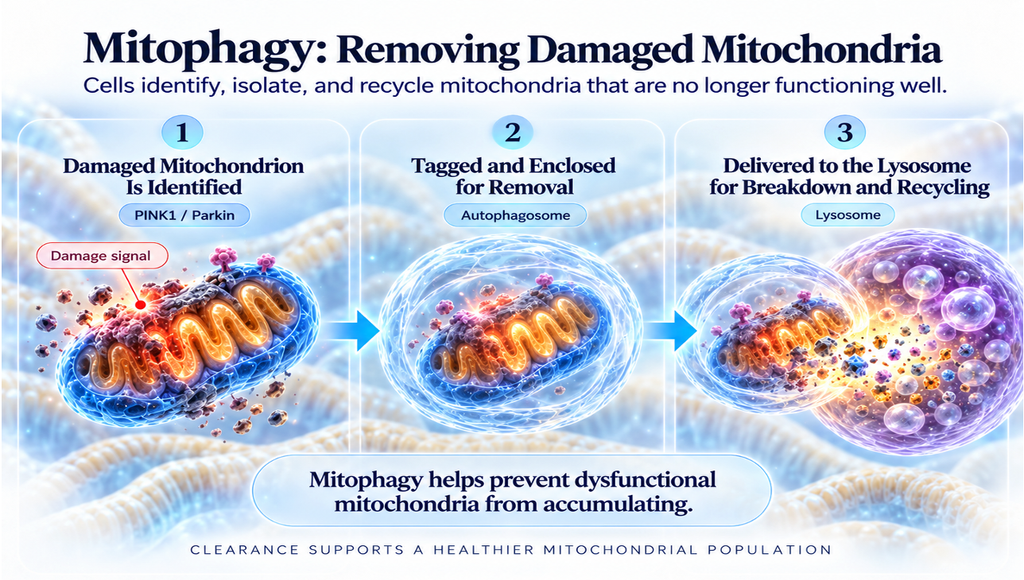
One of the best-studied mitophagy pathways involves two proteins called PINK1 and Parkin. In a healthy mitochondrion, PINK1 is normally imported and rapidly processed. When mitochondrial membrane function becomes sufficiently impaired, that process changes, and PINK1 begins to accumulate on the outer mitochondrial membrane.
PINK1 then helps activate Parkin, which places molecular tags called ubiquitin on proteins associated with the damaged mitochondrion. Those tags help recruit the machinery that recognizes the mitochondrion for removal. The biology is more complex, and PINK1/Parkin is not the only mitophagy pathway, but it provides a useful example of how cells can identify mitochondria that are no longer performing adequately.
The Lysosome Has to Finish the Job
Recognizing a damaged mitochondrion is not enough. Tagging it is not enough. Even enclosing it within an autophagic structure is not enough. The damaged material must ultimately be delivered, degraded, and cleared, and that requires healthy lysosomal function.
Scientists use the term autophagic flux to describe the movement through the entire recycling pathway. A cell may show signs that autophagy has been activated, yet if the later stages of clearance are impaired, damaged material can still accumulate. A recycling program works only if the material reaches the recycling center and is processed.
Removal Must Be Balanced by Renewal
If cells continually removed damaged mitochondria without renewing mitochondrial capacity, energy production would eventually decline. That is why mitophagy must be coordinated with mitochondrial biogenesis, the process by which cells expand and renew their mitochondrial network.
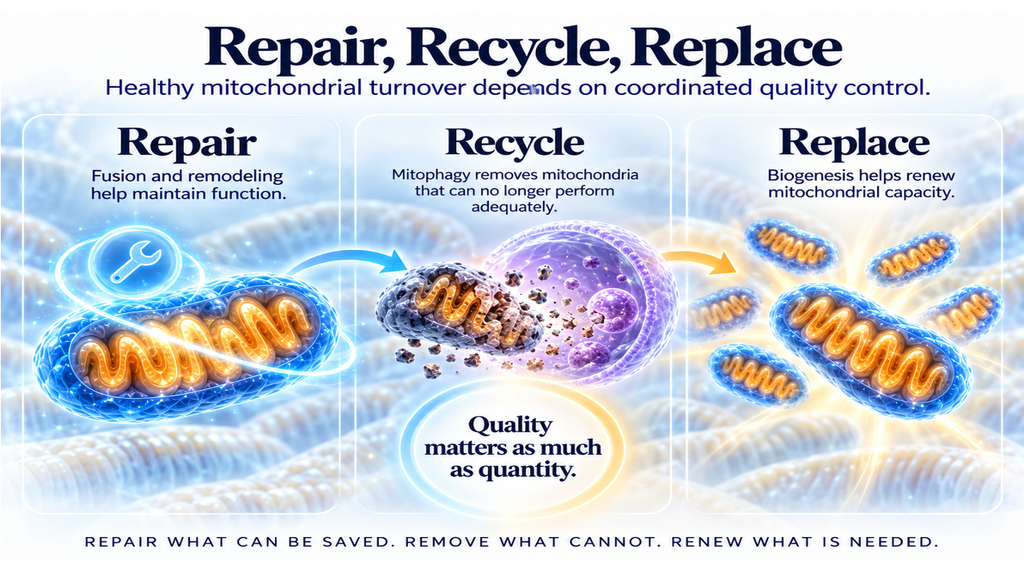
Biogenesis does not mean a completely new mitochondrion suddenly appears from nothing. Existing mitochondria grow, synthesize new proteins, replicate mitochondrial DNA, expand their membranes, and divide. Healthy turnover therefore depends on coordination: fusion helps maintain the network, fission helps remodel it and isolate damage, mitophagy removes mitochondria that can no longer function adequately, and biogenesis helps restore mitochondrial capacity.
| The goal is not simply more mitochondria. The goal is a healthier mitochondrial population. |
Why Quality Control Becomes More Important With Aging
Aging is often described as an accumulation of cellular damage. Another way to think about it is as a gradual decline in the ability to manage that damage efficiently. Mitochondria will always experience some stress. The critical question is whether cells can still recognize dysfunctional mitochondria, repair them when possible, remove them when necessary, and renew the network efficiently.
When quality-control systems become less effective, damaged mitochondria may persist longer than they should. They may produce less ATP, disrupt redox balance, alter cellular signaling, and release mitochondrial components that act as danger signals. This creates an important link among mitochondrial dysfunction, cellular stress, and chronic inflammation.
The issue, therefore, may not simply be whether mitochondria become damaged with age. A more useful question is whether the cell can still clean up that damage effectively.
Exercise Is a Mitochondrial Quality-Control Signal
Exercise does more than increase energy demand. It also provides a physiological signal that can stimulate mitochondrial remodeling, mitophagy, biogenesis, and other quality-control pathways. Temporary shifts in ATP demand, calcium signaling, and oxidative stress signal to the cell that its energy system is being challenged, prompting the mitochondrial network to adapt. This is another example of hormesis: a manageable stress can trigger repair, renewal, and greater resilience.
Urolithin A: An Emerging Mitophagy Strategy
Mitochondrial quality control has also become a focus of nutritional and therapeutic research. One compound receiving considerable attention is urolithin A, a metabolite that certain gut bacteria can produce from compounds found in foods such as pomegranates and certain nuts. Because gut microbiomes differ, people vary considerably in how much urolithin A they produce naturally.
Preclinical research suggests that urolithin A can influence pathways involved in mitophagy. Human studies have also reported changes in mitochondrial biomarkers and some measures of muscle endurance, while results for larger functional outcomes have been less consistent. For that reason, urolithin A is best viewed as an emerging quality-control strategy rather than a proven method for reversing mitochondrial aging. The mechanism is compelling. The clinical story is still developing.
More Mitochondria Are Not Necessarily Better Mitochondria
This may be the most important lesson in mitochondrial quality control. If a cell simply produced more mitochondria without removing dysfunctional ones, the result would not necessarily be a healthier cell. Likewise, increasing mitochondrial removal without adequate renewal would make little biological sense.
What matters is turnover. A healthy mitochondrial system must continually decide what to repair, what to isolate, what to remove, and what to renew. Quality matters as much as quantity.
How We Think About Mitochondrial Quality
I think this principle aligns directly with how we approach regenerative medicine. For years, much of medicine has focused on what we can add: more nutrients, more antioxidants, more NAD+, more signaling molecules, more oxygen, or more cellular energy support. Those approaches may have value, but healthy biology also depends on what the cell can remove, repair, and renew.
A healthy mitochondrial system requires balance between energy production and maintenance, stress and recovery, damage and repair, removal and renewal. The goal is not simply to push mitochondria to produce more ATP. It is to support the biological environment that allows cells to maintain a healthy mitochondrial population over time.
| Repair what can be saved. Recycle what can no longer function. Replace lost capacity through renewal and biogenesis. |
Mitochondrial health is not simply about producing more energy. It is about maintaining a population of mitochondria that are efficient, adaptable, and continuously renewed. The important question is not only how many mitochondria a cell has, but how many of them are still doing their job well.
Next in the Series: Cellular Signaling and Mitochondrial Function
How does the cell know when it needs more energy, when it should build new mitochondria, when nutrients are abundant, or when it should shift toward repair and survival? That requires another layer of mitochondrial biology: cellular signaling.
In Part Four, we will explore pathways including AMPK, SIRT1, and PGC-1alpha and examine how exercise, fasting, nutrient availability, NAD biology, and cellular stress communicate with the mitochondrial network. Mitochondria do not make these decisions alone. They are part of a much larger cellular communication system, and understanding that system may be essential to understanding metabolism, resilience, and healthy aging.
Dr. Joseph Purita