
A flight of stairs becomes something you plan around. A short walk ends with a sore knee. When knee arthritis starts shrinking your everyday routine, an injection of platelet-rich plasma (PRP) or stem cells can sound like a way to regain some freedom without surgery.
The useful question is what improvement these treatments can realistically offer. Some people experience less pain and better function, but research results for both PRP and stem cell injections are mixed. Neither is an established way to rebuild worn cartilage or reverse arthritis. This guide explains what each treatment is, what the evidence shows, how the procedures work and the expectations that matter when weighing treatment.
1. What PRP and Stem Cell Injections Can Do
Platelet-rich plasma explained
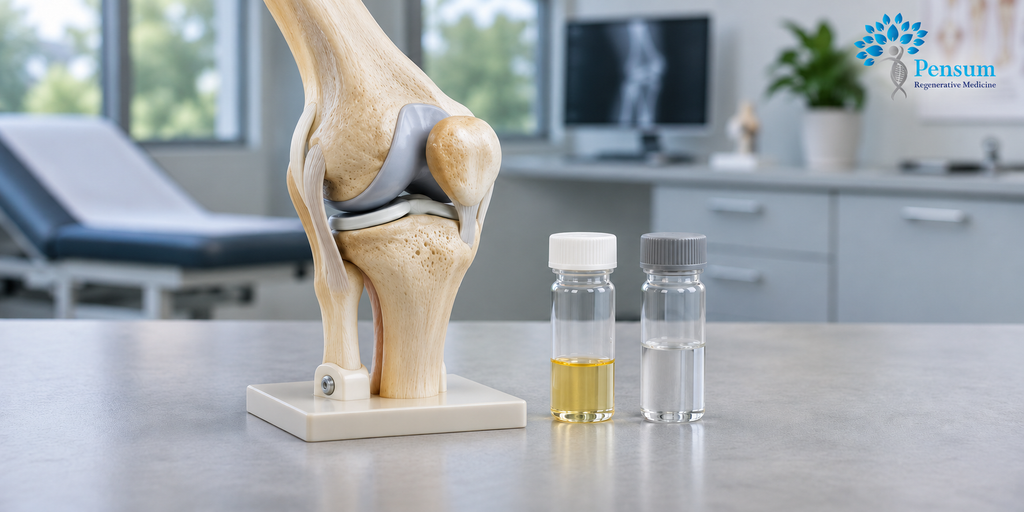
Platelet-rich plasma, or PRP, is prepared from a sample of your own blood. A centrifuge separates the blood components to produce a preparation containing concentrated platelets. Platelets release proteins involved in healing and cell signaling. The preparation is then injected into the affected area.
Stem cell injections explained
“Stem cell injection” is a broad label that covers several different products. For knee arthritis, the cells most often discussed are mesenchymal stromal cells (often called mesenchymal stem cells, or MSCs). Common sources include:
- Bone marrow aspirate concentrate (BMAC): bone marrow is drawn from your own pelvic bone and concentrated on the same day.
- Adipose-derived cells, including stromal vascular fraction (SVF): a small amount of your own fat is collected and processed.
- Donor-derived cells: for example, cells manufactured from donated umbilical cord tissue.
These products differ in how they are obtained, how many cells they contain and how they are processed. Results from one type should not be assumed to apply to another.
Two different treatments
PRP and stem cell injections are distinct treatments. PRP contains platelets and plasma, not stem cells. Stem cell preparations involve collecting or sourcing cells and, in most cases, a more involved procedure. They should not be described as the same product or assumed to produce the same effects.
For knee osteoarthritis, the realistic intended outcome of either treatment is symptom improvement: less pain, easier movement and better daily function.
Symptom relief and structural repair
Pain and cartilage damage are related, but they are not interchangeable measures. A person can feel better without showing new cartilage growth on a scan. Equally, an injection does not correct every cause of knee pain. A useful treatment discussion separates symptom improvement from claims about repairing the joint.
KEY POINT: An improvement in pain or walking ability does not prove that cartilage has regrown. Neither PRP nor stem cell injections should be presented as a cure for knee arthritis.

2. The Evidence for Knee Arthritis
PRP: research showing meaningful improvement
A meta-analysis of 18 randomised trials in the American Journal of Sports Medicine found that PRP outperformed placebo for some pain and function outcomes in knee osteoarthritis. It also found that preparations with higher platelet concentrations gave better and more durable results. This supports considering PRP as a possible symptom-management option, while leaving important questions about the best preparation and treatment schedule.
PRP: why the findings are not uniform
The RESTORE randomised clinical trial offers an important counterpoint. It studied 288 adults aged 50 or older with mild to moderate knee osteoarthritis. At 12 months, three weekly PRP injections did not produce a statistically significant improvement over saline injections in knee pain or medial tibial cartilage volume.
Professional guidance also differs. The 2019 American College of Rheumatology/Arthritis Foundation guideline recommended against PRP for knee osteoarthritis, while the American Academy of Orthopaedic Surgeons rated the evidence as limited (PM&R KnowledgeNow).
Stem cells: what pooled studies suggest
Several meta-analyses of smaller trials report improvement in pain and function after stem cell injection. For example, a 2025 meta-analysis of eight randomised trials found better pain and function scores at 6 and 12 months compared with control treatments, without a significant increase in adverse events.
Trials also differ in cell source, dose, processing and number of injections, so the best product and protocol remain unsettled.
3. Arthritis Severity and Treatment Suitability
The diagnosis matters
Knee pain can involve osteoarthritis, tendons, a meniscus injury or more than one problem. A treatment aimed at arthritis will not necessarily address a different source of pain. Clinical history and examination help establish the likely cause; X-rays can show joint-space changes and other features of osteoarthritis. Additional imaging is used when the clinical picture requires it.
Mild, moderate and advanced arthritis
Pensum recommends considering stem cells and PRP for mild to moderate knee osteoarthritis that remains symptomatic despite conservative care. Most stem cell trials have also focused on mild to moderate disease. That evidence should not be stretched into a promise that an injection will restore a severely damaged joint.
With advanced arthritis, expectations deserve particular care. Persistent pain, loss of movement and major difficulty with daily activities may require a broader discussion of treatment, including surgery. An injection should not delay reassessment when symptoms continue to substantially limit life.

4. What Happens During the Procedure
PRP: blood collection, preparation and injection
A typical PRP appointment involves taking a blood sample, processing it in a centrifuge and injecting the prepared PRP into the knee using a sterile technique. Ultrasound may be used to guide placement. The blood volume, preparation system, use of local anaesthetic and number of appointments vary between protocols.
Stem cells: harvest, processing and injection
Donor-derived products do not need a harvest from you, but the source, processing, testing and regulatory status of the product should be documented and explained before treatment.
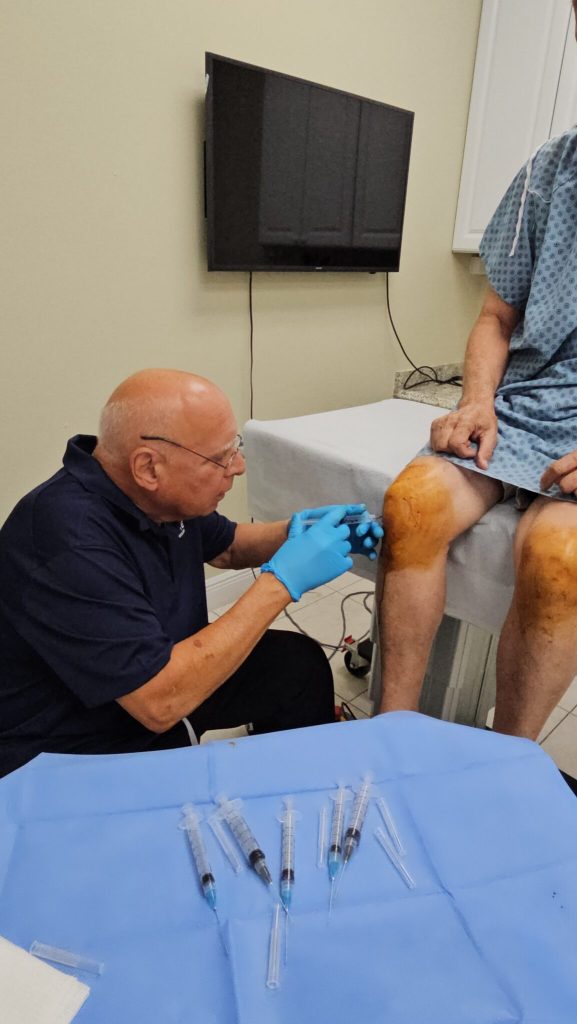
Procedures using your own cells add a collection step. For bone marrow concentrate, marrow is drawn from the back of the pelvic bone under local anaesthetic. For adipose-derived cells, a small volume of fat is removed, usually from the abdomen or thigh, through a small incision. The sample is processed and then injected into the knee, often with imaging guidance. Some protocols combine cells with PRP.
Your own tissue is not risk-free
PRP or cells made from your own blood or tissue do not make the procedure risk-free. The injection still passes through the skin and into the joint, and stem cell procedures add a second site where tissue is collected. Infection prevention, sterile processing and accurate placement remain important.
Preparation before the appointment
Medication history matters, especially medicines that affect bleeding or platelet function. Current infection, antibiotic use, allergies and relevant medical conditions also affect planning. Do not stop prescribed medicines, including blood thinners, on your own. Medication instructions need to match the procedure and the reason those medicines were prescribed.
5. Recovery and Treatment Results
Early soreness and later response
The knee may feel sore after an injection, and temporary discomfort is different from the longer-term response being assessed. After a stem cell procedure, the harvest site may also be bruised or sore for several days. Immediate relief is not a reliable test of whether treatment will help. Research commonly measures outcomes over months, rather than judging success in the first few days.
Return to work, exercise and sport depends on symptoms, the physical demands of the activity and the treatment plan. There is no single recovery timetable that applies equally to a desk worker, a runner and someone who spends a shift lifting or climbing.
Measuring progress in everyday life
A useful outcome is specific: walking farther before pain begins, managing stairs more comfortably or completing a normal day with fewer interruptions. Recording these activities before treatment provides a clearer comparison later. Rehabilitation and appropriate exercise remain part of the wider plan; an injection does not replace the need to maintain strength and movement.
Pensum uses the Western Ontario and McMaster Universities Osteoarthritis Index (WOMAC) index to measure pain levels before and after at various time frames.
6. PRP and Stem Cells Alongside Other Arthritis Treatments
Arthritis care usually combines several approaches. The table below explains the different roles of common options; it is not a ranking or a personalized treatment recommendation.
| Option | Main role | Important limit |
| Exercise and rehabilitation | Maintain strength and movement | Requires a suitable, ongoing program |
| Pain medicines | Help manage symptoms | Choice depends on health risks and other medicines |
| Corticosteroid injection | Short-term relief of pain and inflammation | Effect is often temporary; repeated use needs review |
| PRP injection | Potential pain and function improvement | Rich in growth factors that stimulate tissue repair, reduce inflammation and help relieve pain. |
| Stem cell injection | Potential pain and function improvement | Potential to relieve joint pain, treats inflammation, restore function naturally |
| Joint surgery | Address severe, persistent joint problems | Requires surgical assessment and recovery |
Exercise, weight management where appropriate and other established measures remain relevant whether or not PRP or stem cells are used. The NIAMS osteoarthritis resource describes these options and the role of surgery when joint damage and symptoms are severe. Treatment choices depend on the individual benefits, risks and limits of each approach.
7. Risks and Warning Signs
Potential complications
Possible problems with either injection include a temporary increase in pain or swelling, bleeding, infection and injury to nearby tissues or nerves. Stem cell procedures add risks at the harvest site, such as pain, bruising, bleeding or, rarely, infection. Cell products also carry risks related to processing, including contamination.
Symptoms that need prompt attention
Increasing redness or heat around the knee or harvest site, fever, drainage from an injection or harvest site, or severe and worsening pain warrants prompt medical assessment. These symptoms should not simply be dismissed as a normal recovery flare. Follow the aftercare instructions provided for the procedure and use the contact pathway supplied by the treating team.
8. Knee Treatment at Pensum
For people exploring knee treatment in Grand Cayman, the starting point is a clear diagnosis and an honest view of what each option can achieve. PRP or stem cell injections may be part of that discussion when arthritis symptoms remain troublesome despite appropriate conservative care.
Explore Pensum’s stem cell and PRP treatment options for an overview of its regenerative medicine services. A consultation can establish which options fit your knee condition, previous treatment and daily goals, and explain the source, preparation and regulatory status of any cell product being considered. Individual suitability and the proposed protocol require clinical assessment.
Medical information: This article provides general education and is not a substitute for individual medical advice. Clinical review is pending before publication.