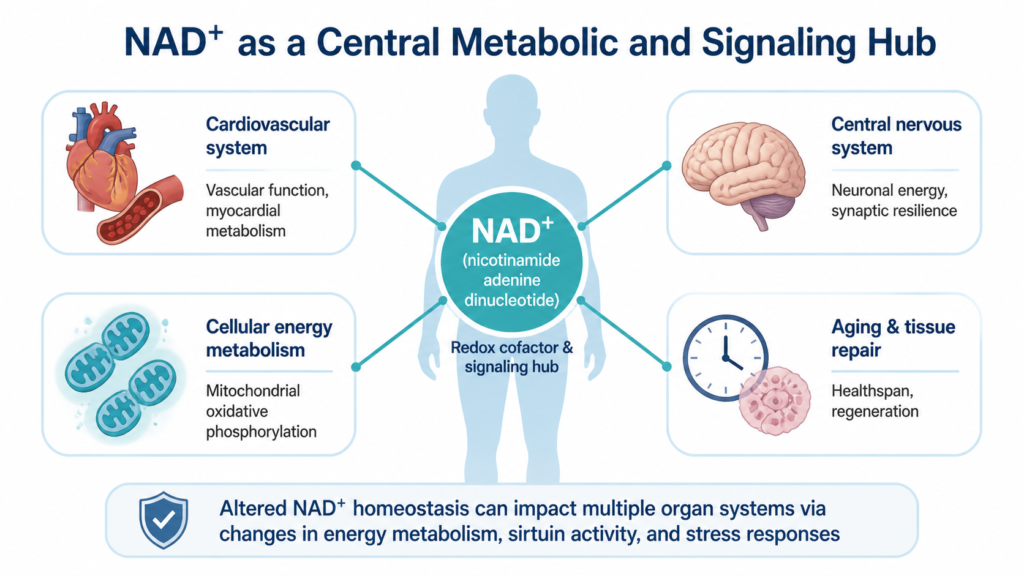
When most people hear about NAD, they think of IV drips, energy, or anti-aging buzzwords. In reality, NAD and its partner NADH form a central cellular system that helps link how the body burns fuel, how cells respond to stress, and how tissues change with age. In clinical longevity medicine, this system matters because NAD is not just a helper for energy production. It also acts as a signaling molecule that helps regulate DNA repair, mitochondrial function, circadian rhythms, and the activity of enzymes tied to healthy aging.
Understanding NAD and NADH
NAD and NADH are two forms of the same molecule cycling back and forth during metabolism. NAD is the oxidized form, while NADH is the reduced form that carries electrons generated during energy production.
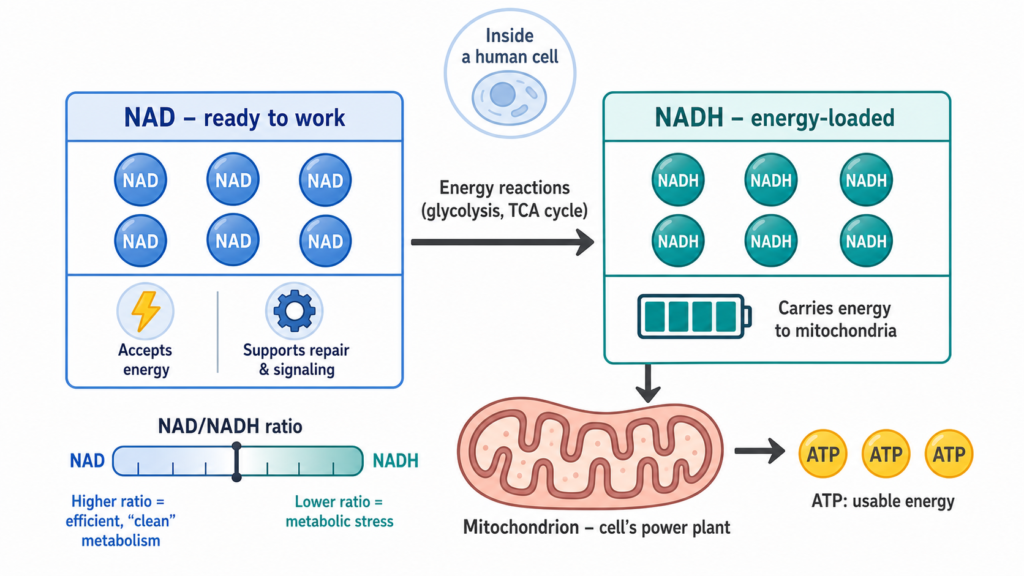
A simple way to think about them is that NAD is the “ready-to-work” form and NADH is the “energy-loaded” form. As cells convert food into fuel, NAD becomes NADH and then is recycled back again, especially inside mitochondria. The balance between these two forms is called the NAD/NADH ratio. That ratio gives important information about the cell’s metabolic state, redox balance, and ability to generate energy efficiently.
What inspired me to write this article was a journal article I recently shared on LinkedIn. The original scientific review explains that NAD and NADH are not just basic energy cofactors. It presents them as signaling molecules that help cells sense metabolic stress, regulate DNA repair, influence mitochondrial function, and shape the biology of aging. The authors place special emphasis on sirtuins, showing that these longevity-associated enzymes primarily respond to NAD availability rather than directly sensing the NAD/NADH ratio, while still recognizing that the ratio itself remains an important marker of cellular metabolic health. Here is the article for those who wish to read it: https://pmc.ncbi.nlm.nih.gov/articles/PMC5648639
Why the NAD/NADH Ratio Matters
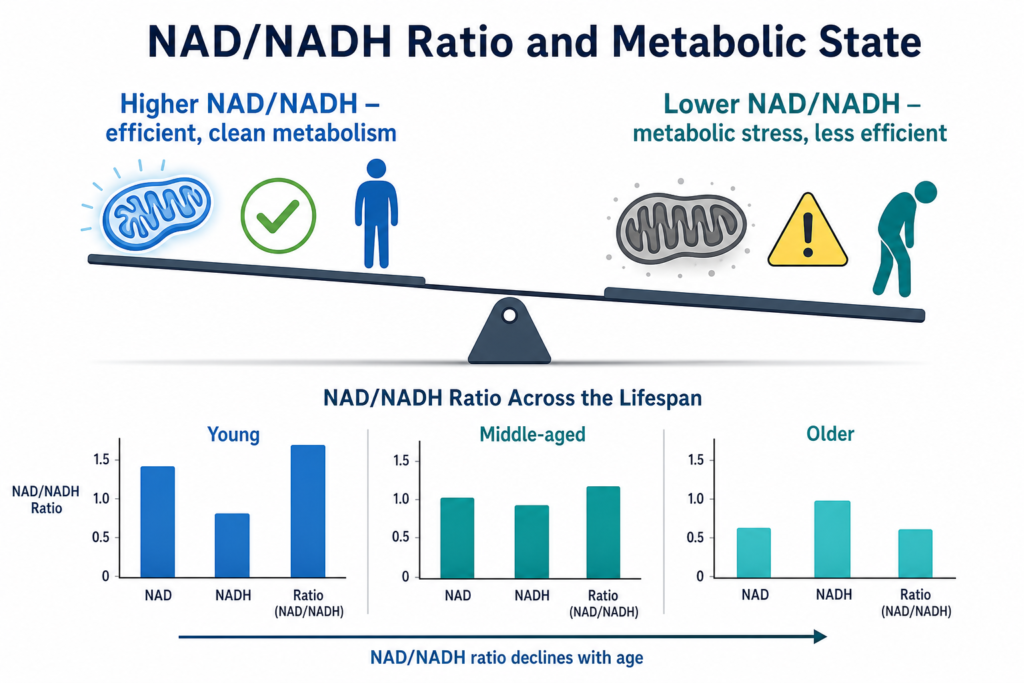
Both NAD and NADH are important, but their ratio changes in meaningful ways across nutrition, stress, disease, and aging. In general, a higher NAD/NADH ratio is associated with a more efficient and metabolically favorable state, while a lower ratio tends to reflect metabolic stress or reduced cellular efficiency.
The body does not keep a single pool of NAD and NADH. Instead, there are separate pools in the nucleus, cytosol, and mitochondria, and these compartments can behave differently under stress or with age. For example, nuclear and cytosolic free NAD pools are similar, while the mitochondrial pool is more distinct and separately regulated.
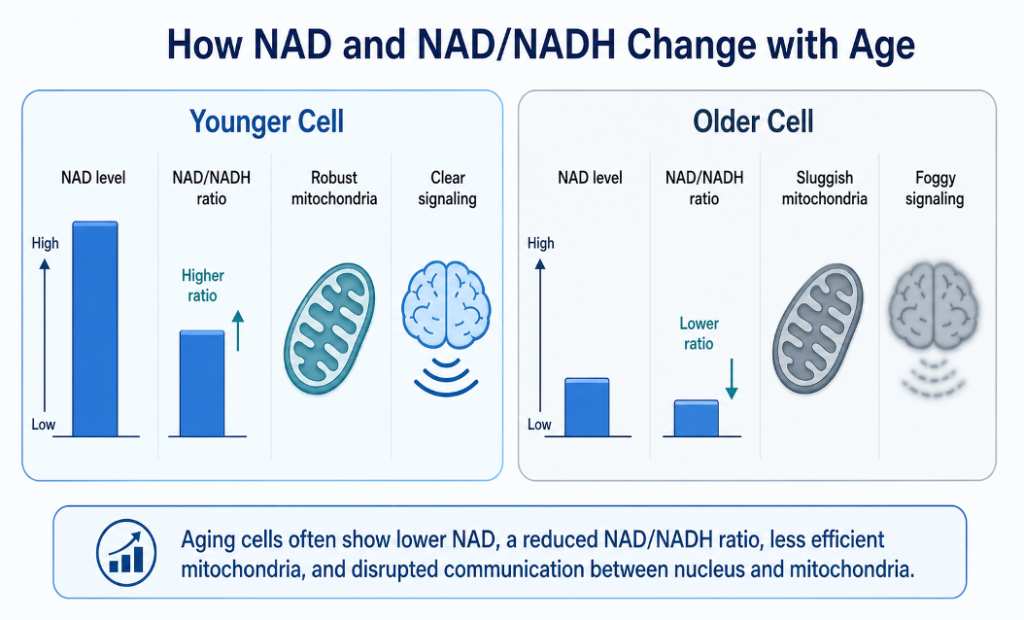
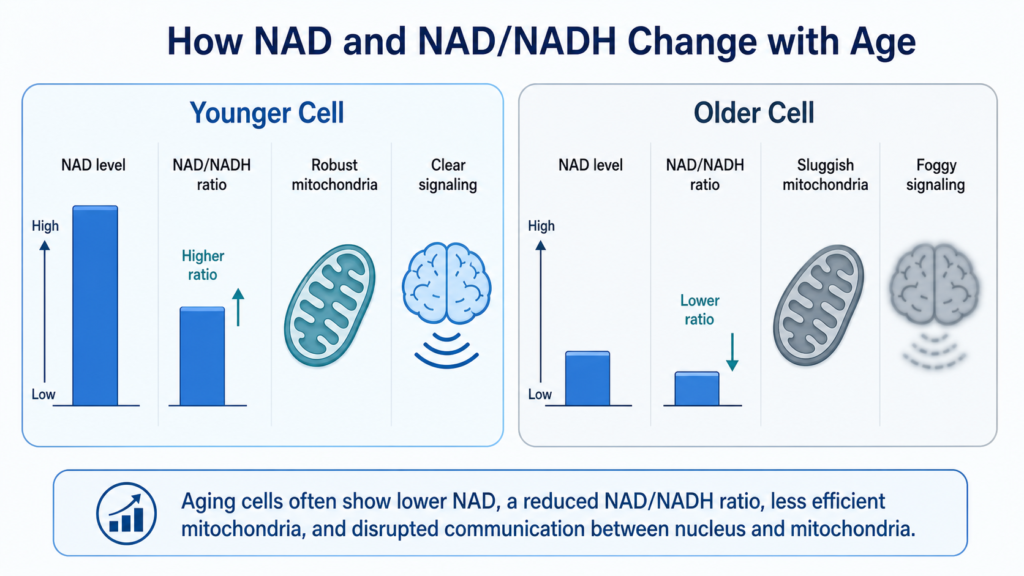
This compartmental view is important because aging is not simply a story of “less energy.” Aging can involve lower NAD, higher NADH in some settings, and a decline in the NAD/NADH ratio, changes that are linked to a more stressed and less efficient metabolic pattern.
Sirtuins and Healthy Aging
A major focus of this biology is the sirtuin family, a group of enzymes that depend on NAD to function. Sirtuins help remove chemical tags from proteins, allowing them to influence gene expression, DNA repair, mitochondrial performance, and stress resistance.
This is one reason sirtuins are often discussed in longevity medicine. They sit at the intersection of metabolism and repair, helping cells translate nutrient and stress signals into protective responses.
A key conclusion from the scientific work behind this summary is that sirtuins appear to sense NAD itself more than they sense NADH or the NAD/NADH ratio directly. In simple terms, normal free NAD levels fall within the range where sirtuins can respond, while typical NADH levels are too low for sirtuins to act as effective NADH or ratio sensors.
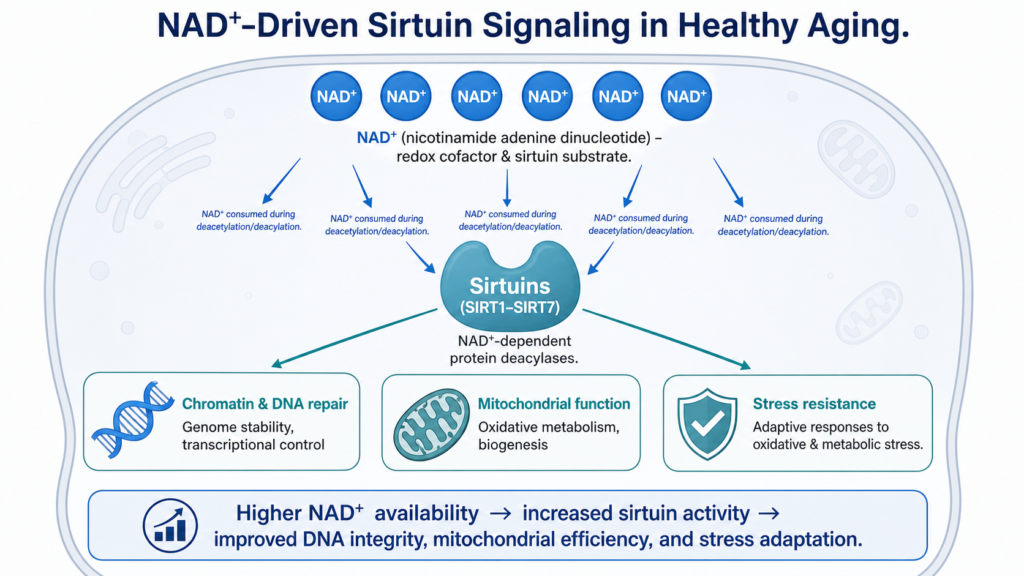
For practical purposes, the NAD/NADH ratio still matters because it reflects the overall metabolic environment of the cell, but for sirtuins, the crucial question is whether enough usable NAD is available for them to carry out their repair and regulatory work.
What Changes with Age
NAD biology connects directly to aging. NAD levels rise and fall with circadian rhythm, fasting, exercise, and nutrient availability, but they also tend to decline with aging and cellular senescence.
Age-related changes in the brain and muscle often include falling NAD, rising or relatively higher NADH, and a declining NAD/NADH ratio. These shifts are associated with reduced sirtuin activity, impaired communication between the nucleus and mitochondria, and a more dysfunctional energy pattern sometimes described as pseudohypoxic or “Warburg-like.”
For patients, the practical takeaway is that healthy aging depends not only on generating energy but also on maintaining the signaling environment that enables cells to repair themselves, adapt to stress, and remain metabolically flexible.
NAD and Niagen in Clinical Practice
NAD and Niagen are closely related but not the same. NAD is the active molecule used directly inside cells, while Niagen is nicotinamide riboside, a precursor that the body converts into NAD through its salvage pathway. That means NAD is the finished product, while Niagen is one of the ingredients the body uses to synthesize more NAD. Both are designed to support the same broad biologic target: healthier NAD availability and improved support for NAD-dependent repair and metabolic pathways.
In practice, both IV NAD and IV Niagen are used to support similar goals: raising NAD and helping cells move toward a healthier metabolic and repair state. Early clinical experience and emerging data suggest that IV Niagen is often better tolerated and can be infused more quickly than IV NAD, while still increasing NAD levels. These therapies are best viewed as different routes to the same destination rather than completely different treatments—one delivers NAD directly, while the other provides a precursor that cells convert into NAD over time. At the same 500 mg dose, IV Niagen and IV NAD are both designed to raise NAD⁺ levels and support the cell’s energy and repair systems, including mitochondrial function and longevity-related enzymes like sirtuins, helping shift metabolism toward a more youthful, resilient state. However, early comparative data indicate that 500 mg IV Niagen may boost NAD⁺ somewhat more in the short term than 500 mg IV NAD, and many patients find Niagen infusions easier to tolerate, with shorter drip times and fewer uncomfortable sensations such as flushing or chest pressure.
How NAD and Niagen Affect the NAD/NADH Ratio
Because Niagen increases the body’s ability to make NAD, and NAD is constantly cycling to NADH and back, both strategies can influence:
- Total NAD levels
- The NAD/NADH ratio, especially in tissues under metabolic stress
When NAD levels rise:
- Sirtuins and other NAD-dependent enzymes have more fuel to run repair and longevity programs.
- As metabolism becomes more efficient, cells can gradually shift away from a chronically “reduced” state (too much NADH) toward a healthier NAD/NADH balance.
Clinically, the goal is not just to “pour in” NAD, but to restore a healthier NAD environment and NAD/NADH ratio so cells can behave more like they do in youth—more efficient, more flexible, and better at repair.
Tolerability: Why Many People Find IV Niagen Easier
When given intravenously, Niagen (NR) often tends to be more easily tolerated than some IV NAD protocols. IV Niagen feeds into the natural NAD “factory.” Cells gradually convert it into NAD, which often creates a smoother experience during and after an infusion. More aggressive IV NAD protocols can be very effective but may sometimes cause temporary sensations such as warmth, flushing, chest pressure, or nausea if infused too quickly or at higher doses.
Both IV NAD and IV Niagen aim at the same core biology:
- Raising NAD
- Supporting sirtuin and other NAD-dependent pathways
- Helping move the NAD/NADH balance in a healthier direction
The difference is in how they get there and how the treatment feels. IV NAD is the classic, direct approach, but may require slower infusions for comfort. IV Niagen often allows shorter, more comfortable infusions while still boosting NAD and influencing the NAD/NADH axis.
In the clinic, the choice between them or the decision to combine them is based on an individual’s health status, goals, and prior experience.
How NAD and the NAD/NADH Ratio Change with Age
Across many studies, aging is associated with:
- Lower NAD in multiple tissues
- Changes in NADH that often lead to a lower NAD/NADH ratio
- Downstream effects such as reduced sirtuin activity, impaired communication between nucleus and mitochondria, and a shift toward less efficient, more stressed energy production
Clinically, this tends to show up as:
- Slower recovery
- More fatigue and “brain fog”
- Increased inflammation and oxidative stress
- Higher risk of chronic, age-related diseases
By targeting both NAD levels and, indirectly, the NAD/NADH ratio, the aim is to push the system back toward a more youthful metabolic signature.
Where NAD and Niagen Fit into a Longevity Strategy
For longevity and regenerative medicine, current evidence suggests:
- Raising NAD supports sirtuins and other NAD-dependent enzymes that handle DNA repair, mitochondrial function, and cellular stress resistance.
- A healthier NAD/NADH ratio reflects cleaner, more efficient metabolism and less “stuck in stress mode” biochemistry.
- Lifestyle factors—caloric load, nutrient timing, movement, sleep, and circadian rhythm—strongly influence both NAD and the NAD/NADH ratio.
In practice, NAD and Niagen are usually integrated with:
- Nutritional strategies such as time-restricted eating and anti-inflammatory nutrition
- Exercise programs that challenge and rebuild mitochondrial capacity
- Sleep optimization and circadian-friendly routines
- Additional regenerative and cellular therapies, when appropriate
The goal is not just to raise NAD on a lab test. It is to rebalance the NAD/NADH environment and provide cells with the conditions they need to produce energy efficiently, repair damage, and age more slowly.
The Bottom Line for Patients
- NAD and NADH form a dynamic pair that helps run the cellular energy system and influences how cells age.
- The amount of NAD and the NAD/NADH ratio both matter for healthy metabolism, repair, and resilience.
- NAD-dependent enzymes like sirtuins rely mainly on NAD as their fuel, which is why many longevity strategies focus on safely boosting NAD.
- NAD and Niagen are two tools—with different routes and tolerability profiles—used to support these pathways and help move the cellular environment back toward a more youthful state. Dr. Purita