
We already know that exercise is one of the most powerful interventions for improving healthspan. Its effects extend far beyond cardiovascular fitness or weight control. Exercise influences metabolism, muscle, mitochondrial function, inflammation, vascular health, and the brain. Now, an intriguing new study suggests that even a single session of moderate exercise may help protect memory when we do not get enough sleep.

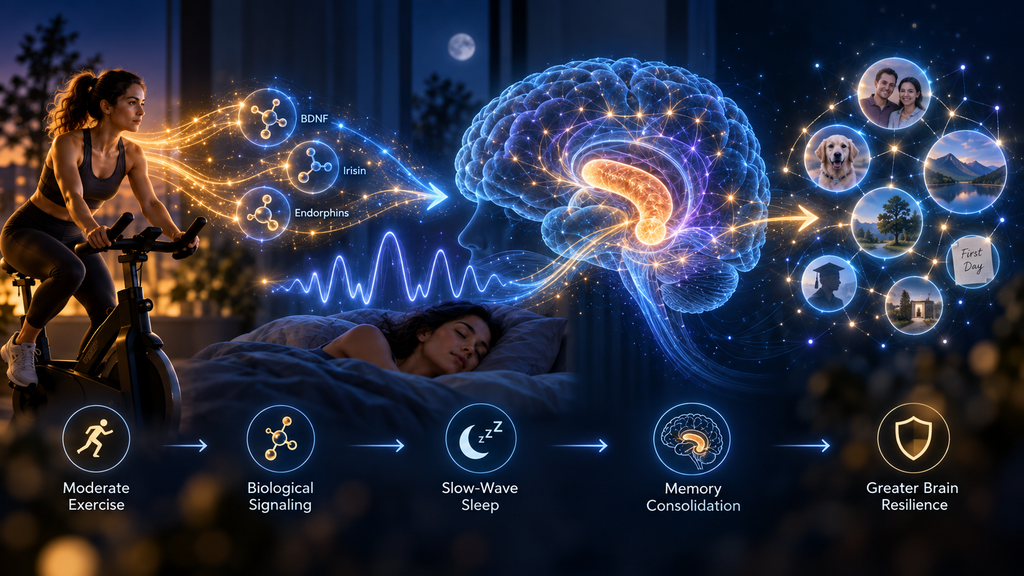
Figure 1. How moderate exercise may support memory resilience through biological signaling, slow-wave sleep, and overnight memory consolidation.
An occasional poor night of sleep is almost unavoidable. Travel, work schedules, stress, family responsibilities, and simply staying up too late can shorten even the best sleeper’s night. One of the first places we often notice the consequences is in the brain. Concentration becomes more difficult, our thinking may feel slower, and our ability to learn and remember new information can suffer.
Researchers recently posed a fascinating question: Could exercise make the brain more resilient to a night of poor sleep?
Putting Exercise, Sleep, and Memory to the Test
In a study published in the journal SLEEP, researchers studied 88 healthy young adults and randomly assigned them to four conditions. Some participants were given about 8.5 hours of sleep, while others had their sleep restricted to 4.5 hours. Within each sleep condition, participants either rested or completed a 30-minute session of moderate-intensity stationary cycling.
Importantly, this was not an exhausting workout. The participants exercised at approximately 55 to 60 percent of their maximal oxygen consumption, indicating a moderate aerobic effort rather than high-intensity training.
Later that evening, participants learned 80 face-name combinations. Their memory was tested immediately and again the following morning. This allowed the researchers to determine not only how well participants initially learned the information but also how effectively their brains retained and consolidated those memories overnight.
As expected, the participants who slept only 4.5 hours without exercising performed worse on the delayed memory test the following morning. Sleep restriction interfered with their ability to retain the information they had learned the night before.
The most interesting finding occurred in the group that exercised before the sleep-restricted night. Those participants performed significantly better the next morning than the sleep-restricted group that had not exercised. In fact, their memory performance was not statistically different from that of the participants who had been given a full night of sleep.
That does not mean exercise can replace four hours of lost sleep. It does, however, suggest something very interesting: a single session of moderate exercise may temporarily increase the brain’s resilience to some of the cognitive consequences of acute sleep loss.
Why Deep Sleep Matters for Memory
The researchers also examined what happens during sleep itself. This is important because learning does not stop when we close a book, finish a conversation, or leave a meeting. Newly acquired memories remain relatively fragile, and the brain continues to process and stabilize them during sleep.
One of the most important stages involved in this process is slow-wave sleep, commonly called deep sleep. Slow-wave sleep occurs predominantly during the early part of the night and appears to play an important role in consolidating certain types of memory.
In this study, the proportion of slow-wave sleep statistically mediated the relationship between exercise and next-morning memory performance. In simpler terms, part of the apparent protective effect of exercise appeared to be connected to the amount of deep sleep participants obtained afterward.
That finding offers an intriguing biological link between two behaviors we already know are critical for brain health: exercise and sleep.
Exercise Is More Than a Workout
We often think about exercise primarily in terms of burning calories, controlling weight, improving cardiovascular fitness, or maintaining muscle. Those benefits are important, but they represent only part of what exercise does biologically.
I prefer to think of exercise as a biological signal. When we exercise, we are sending a message to the body that it needs to adapt. Muscle adapts. Mitochondria adapt. Blood vessels adapt. Metabolism adapts. And the brain adapts.
Exercise also influences cerebral blood flow, insulin sensitivity, inflammatory pathways, and neurotrophic signaling. It has been associated with changes in brain-derived neurotrophic factor (BDNF), which plays an important role in neuronal health, synaptic plasticity, learning, and memory.
This concept becomes especially important as we age. The goal of health and longevity medicine should not simply be to eliminate every possible stressor. That is impossible. The greater goal is to build a body that responds appropriately to stress, recovers from it, and maintains function.
Exercise may be one of the most powerful ways we have to build that physiological reserve.
Exercise Does Not Replace Sleep
However, there is an important caution. This study should not be interpreted as meaning someone can routinely sleep four or five hours per night and compensate by exercising. The research examined a single night of experimentally restricted sleep in healthy young adults. Chronic insufficient sleep is a different situation and has been associated with adverse effects on cardiovascular health, metabolism, immune function, mood, cognitive performance, and overall health.
The researchers also studied one specific form of declarative memory using face-name associations. We do not yet know whether the same protective effect extends equally to executive function, reaction time, complex decision-making, attention, or other cognitive functions that can deteriorate when we are sleep-deprived.
There is another important detail. The participants exercised before learning the face-name pairs and before going to sleep. Therefore, future research will be important to determine exactly how much of the benefit comes from exercise’s effects on learning, how much comes from its effects on sleep, and how much results from the interaction between the two.
The correct takeaway is not that exercise means we need less sleep. A better interpretation is that when an occasional short night is unavoidable, exercise may help make the brain more resilient to some of the consequences.
What This May Mean in the Real World
From a practical standpoint, this study suggests that approximately 30 minutes of moderate aerobic activity before an unusually short night of sleep may be beneficial. The investigators used stationary cycling, so we cannot assume every form of exercise produces the same result. However, activities such as brisk walking, swimming, rowing, or using an elliptical trainer may provide a similar moderate aerobic stimulus.
This study also provides no evidence that harder is necessarily better. The researchers specifically used moderate-intensity exercise, not an exhausting late-night workout. Individuals who find that vigorous evening exercise interferes with their ability to fall asleep should keep that in mind.
The larger lesson is that movement matters.
Building Biological Resilience
For me, the most interesting aspect of this research goes well beyond one workout or one bad night of sleep. It illustrates an idea central to how we think about health and longevity: the human body has a remarkable ability to adapt when it receives the proper biological signals.
Exercise is one of those signals. Sleep is another. Nutrition, muscle mass, metabolic health, mitochondrial function, stress management, and recovery all contribute to our ability to maintain function and withstand the inevitable stresses of life.
No single intervention operates in isolation. Our health ultimately reflects how all of these systems interact.
The goal, therefore, should not be to find one treatment that compensates for every unhealthy behavior. Instead, we should build as much physiological reserve as possible so that when life inevitably creates stress—whether from poor sleep, illness, travel, psychological stress, or physical demands—the body has a greater capacity to respond.
On a personal level, I have often found that when my sleep has not been optimal, exercising the following morning can feel like a saving grace. That differs somewhat from what this study tested, because the researchers examined exercise after a shortened night’s sleep. Nevertheless, both observations point to the same larger principle: movement has remarkably powerful effects on how the brain and body function.
The Bottom Line
We should keep protecting our sleep because good sleep remains foundational to health. Exercise does not replace it. But this study adds another fascinating piece to the puzzle by suggesting that exercise may make the brain more resilient when perfect sleep simply is not possible.
Perhaps the simplest message is this: Sleep builds recovery. Exercise builds resilience. And our brains appear to benefit from both.
Read the Original Research
The study discussed in this article is:
Frimpong E, et al. “Slow-Wave Sleep Mediates the Compensatory Effects of Acute Moderate-Intensity Exercise on Declarative Memory Deficits in Sleep Restriction.” SLEEP. Published online August 26, 2026. DOI: 10.1093/sleep/zsag235.