The Mitochondrion, Part 6: Nitric Oxide and Photobiomodulation
How Blood Flow, Oxygen Delivery, and Light Influence Mitochondrial Function
A Series on Cellular Energy, Resilience, Repair, and Longevity
In Part Five of this series, we explored hormesis—the idea that an appropriate physiologic challenge can stimulate adaptation. Exercise, fasting, heat, cold, intermittent hypoxia, and controlled oxidative stress all send different biological messages to the cell.
But mitochondrial health depends on more than stress and adaptation. Mitochondria also depend on what reaches the cell: oxygen, nutrients, blood flow, and signals that tell the cell how much energy it needs and how to use it.
Two particularly interesting players in this story are nitric oxide and light. Nitric oxide helps regulate blood vessels, oxygen delivery, cellular signaling, and mitochondrial respiration. Red and near-infrared light, through a process known as photobiomodulation, may influence mitochondrial and redox signaling through several proposed cellular mechanisms.
At first, circulation and light may seem like completely different subjects. At the mitochondrial level, however, they intersect in fascinating ways.
Nitric Oxide: Much More Than a Vasodilator
Nitric oxide, or NO, is one of the smallest signaling molecules in human biology. The body produces it throughout and uses it for vascular, nervous, immune, and metabolic signaling. From a mitochondrial perspective, NO is especially interesting because it sits at the intersection of circulation, oxygen delivery, and cellular respiration.
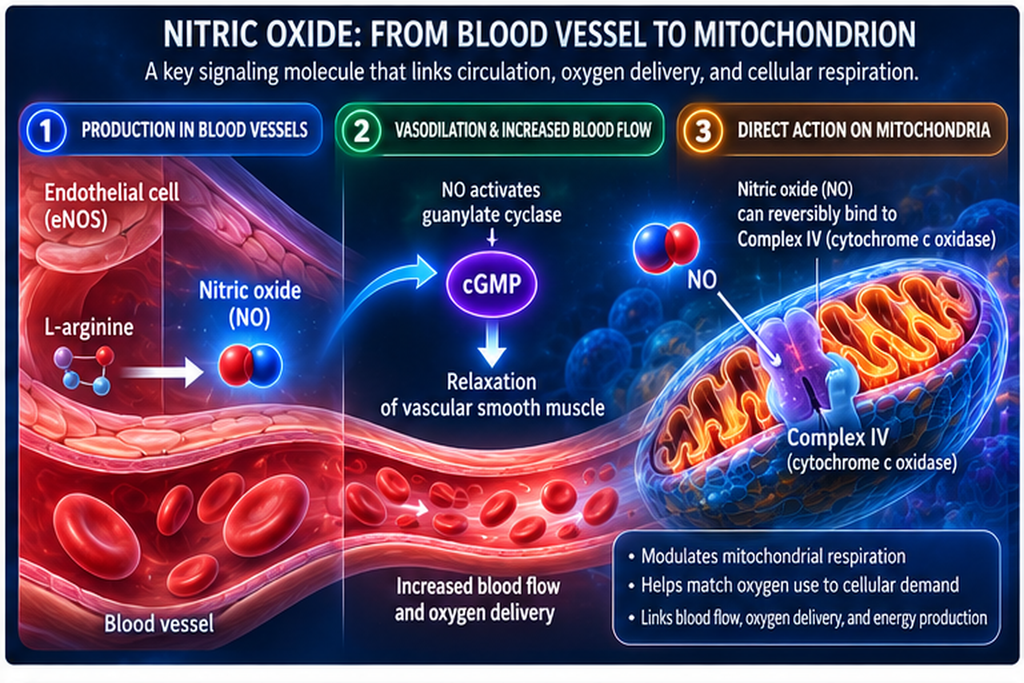
One major source of vascular nitric oxide is the endothelium—the thin cellular lining of our blood vessels. Endothelial cells contain an enzyme called endothelial nitric oxide synthase (eNOS), which generates nitric oxide from the amino acid L-arginine.
The nitric oxide then diffuses into the smooth muscle surrounding the vessel, where it activates soluble guanylate cyclase and increases the signaling molecule cGMP. The smooth muscle relaxes, the vessel widens, and blood flow can increase.
That familiar vasodilator effect is only the beginning of the mitochondrial story.
Why Blood Flow Matters to Mitochondria
We often discuss mitochondrial biology as though everything happens inside the mitochondrion. But before a mitochondrion can use oxygen, oxygen must first reach the tissue.
The lungs must move oxygen into the blood. The heart must pump that blood. The arteries and microcirculation must deliver it to the tissues. Oxygen must then leave the capillary, cross into the cell, and ultimately reach the mitochondrial respiratory chain.
A perfectly healthy mitochondrion cannot sustain normal aerobic energy production if oxygen delivery is inadequate. Vascular and mitochondrial health are therefore closely connected.
Nitric oxide matters not simply because it opens blood vessels, but because it helps regulate the delivery side of cellular energy metabolism.
The Body Has More Than One Way to Generate Nitric Oxide
The eNOS pathway is not the body’s only source of nitric oxide. A second pathway—the nitrate–nitrite–NO pathway—can convert dietary nitrate into nitrite and ultimately into biologically active nitric oxide.
This pathway is particularly interesting because nitrite can serve as a reservoir for NO biology under conditions of lower oxygen availability and increased acidity, such as in exercising tissue. Leafy green vegetables and beets are common dietary sources of nitrate.
The two pathways are not identical, but together they illustrate an important point: nitric oxide biology is closely tied to the tissue’s metabolic conditions.
Nitric Oxide Also Talks Directly to Mitochondria
Nitric oxide does something even more interesting than regulating circulation. It can also interact directly with the mitochondrial respiratory chain.
In Part Two, we discussed Complex IV, also called cytochrome c oxidase. This is the final major complex of the electron transport chain, where oxygen acts as the terminal electron acceptor.
At physiological concentrations, nitric oxide can reversibly interact with cytochrome c oxidase and compete with oxygen. This can temporarily influence the rate of mitochondrial respiration and help couple oxygen use to local cellular conditions.
That does not mean that more nitric oxide automatically produces more energy. A better way to think about NO is as a regulator or metabolic throttle, one that helps coordinate blood flow, oxygen availability, redox signaling, and mitochondrial respiration.
Nitric Oxide Is Another Example of Why Dose Matters
The lesson from Part Five applies here as well. Physiologic nitric oxide is essential for normal signaling, but excessive or poorly controlled reactive nitrogen chemistry is different.
When nitric oxide reacts with large amounts of superoxide, for example, it can form peroxynitrite, a highly reactive species that can damage proteins, lipids, DNA, and mitochondrial components.
So once again, biology is not divided into simple “good molecules” and “bad molecules.” Concentration, location, timing, and the surrounding redox environment matter.
Too little NO can impair normal vascular signaling.
Appropriate NO supports normal physiology.
Excessive nitrosative stress can become damaging.
Photobiomodulation: When Light Becomes a Biological Signal
This brings us to the second half of the story: light.
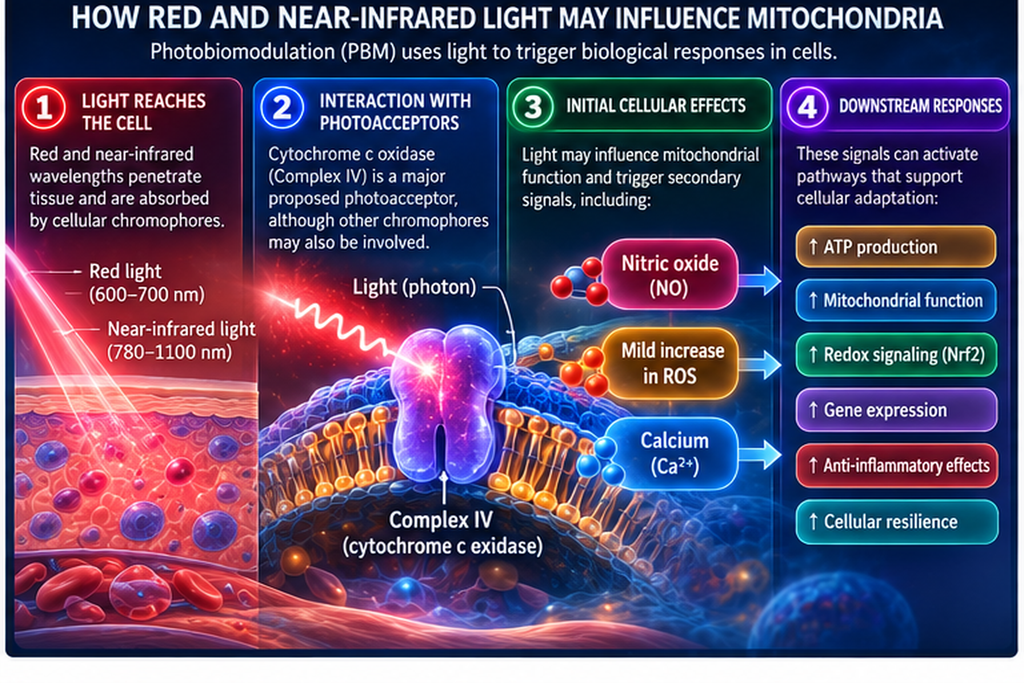
Photobiomodulation, or PBM, uses relatively low-intensity red and near-infrared light to influence biological activity without heating or destroying tissue. This is fundamentally different from a surgical laser. The objective is not to cut, burn, or ablate; it is to deliver photons that cellular molecules can absorb, triggering signaling responses.
Red and near-infrared wavelengths are attractive because they can penetrate biological tissues more effectively than many shorter visible wavelengths. However, actual penetration depends on wavelength, tissue depth, skin and blood content, scattering, device geometry, and the delivered dose.
What Happens When Light Reaches a Cell?
For light to produce a biological effect, photons must first be absorbed. Molecules that absorb light are often called chromophores or photoacceptors.
One of the most widely discussed mitochondrial photoacceptors is cytochrome c oxidase, the same Complex IV involved in oxygen consumption and nitric oxide signaling. A longstanding hypothesis holds that red or near-infrared photons can influence cytochrome c oxidase, thereby affecting electron transport, mitochondrial membrane potential, oxygen consumption, and ATP production.
Another proposed mechanism is particularly relevant to this article. Nitric oxide can bind to cytochrome c oxidase and temporarily influence respiration. Experimental models suggest that light may alter this interaction and, under some conditions, help release NO from the enzyme, potentially changing both mitochondrial respiration and nitric oxide availability.
This is an elegant mechanism, but it should not be presented as the whole story. Cytochrome c oxidase is an important proposed photoacceptor, yet other chromophores, ion channels, flavins, membrane effects, water-related interactions, and signaling pathways may also contribute.
Cytochrome c oxidase is an important proposed mechanism of PBM—but probably not the entire mechanism.
Light May Trigger a Cascade Rather Than Simply “Make More ATP”
Photobiomodulation is sometimes described as though shining light on mitochondria simply causes them to manufacture more ATP. That explanation is probably too simple.
A relatively small photochemical event can generate secondary signals. Depending on the cell, tissue, wavelength, and dose, these signals may include changes in nitric oxide, reactive oxygen species, calcium, mitochondrial membrane potential, transcription factors, inflammatory signaling, and gene expression.
In other words, the photon may only be the beginning. The cell amplifies the signal and determines the downstream response.
The intervention creates the signal. The cell creates the response.
A Small Amount of ROS May Again Be Part of the Signal
Photobiomodulation also brings us back to redox biology. Some experimental studies suggest that PBM can create a small, transient increase in reactive oxygen species.
After Parts One and Five, we know why that should not automatically be considered harmful. A brief change in ROS can act as a signaling event that activates redox-sensitive transcription factors and endogenous defense systems.
The principle again resembles hormesis: a small, controlled signal may trigger a larger adaptive response. Too much oxidative stress is damaging, whereas a transient signaling event may be informative.
Nitric Oxide and Light Are More Connected Than They First Appear
We can now bring the two halves of this article together. Nitric oxide regulates blood flow and can also influence mitochondrial respiration. Red and near-infrared light may alter mitochondrial signaling and NO biology. Mitochondria also influence the redox environment in which nitric oxide operates.
This means photobiomodulation may potentially affect both sides of the oxygen equation: delivery and utilization.
On the delivery side, nitric oxide-related signaling can influence vascular tone, microcirculation, and tissue perfusion. On the utilization side, mitochondrial signaling determines how the cell processes oxygen and electrons once they arrive.
That is why the intersection of nitric oxide, circulation, oxygen, and mitochondrial biology is more interesting than discussing any one of them in isolation.
The Dose of Light Matters
One of the most important lessons in photobiomodulation is that more light does not necessarily produce a larger benefit. PBM often demonstrates a biphasic dose response: too little may produce little effect, an appropriate range may stimulate a response, and a dose beyond that range may become less effective or even inhibitory.
PBM dose is not a single number. It depends on wavelength, irradiance or power density, total energy, treatment time, pulse characteristics, distance from the tissue, target depth, and treatment frequency.
The device matters. The tissue matters. The treatment goal matters.
This helps explain why studies broadly described as “red-light therapy” can produce inconsistent results. Two devices using red or near-infrared light may deliver very different biological exposures.
Red Light and Near-Infrared Light Are Not Identical
Red light is useful for relatively superficial targets, while near-infrared wavelengths generally penetrate somewhat deeper because absorption and scattering vary across tissues and wavelengths.
That does not mean near-infrared light travels unimpeded to deep organs. Much of the delivered light scatters or is absorbed before it reaches deeper structures.
The practical question is therefore not simply “What wavelength is best?” It is “Which wavelength, power, dose, and delivery geometry make sense for the tissue we are trying to influence?”
Photobiomodulation Is Not a Universal Mitochondrial Fix
Researchers have studied PBM across musculoskeletal, neurologic, dermatologic, exercise, wound-healing, and other applications. Some areas have encouraging clinical evidence, while others remain experimental or have produced mixed results.
A plausible mitochondrial mechanism does not mean that every red-light device, wavelength, or treatment protocol will produce a meaningful clinical outcome.
Mechanism matters.
Dose matters.
Tissue matters.
Clinical evidence matters.
The Integrated Picture: Delivery + Utilization + Signal
The larger message from Part Six is that mitochondrial health depends on more than the mitochondrion itself.
The vascular system must deliver oxygen and nutrients. The endothelium helps regulate perfusion through nitric oxide. Mitochondria must then use oxygen appropriately. External signals, including red and near-infrared light, may influence parts of this system through photobiologic and redox pathways.
This creates a useful three-part framework:
1. Improve delivery — circulation, endothelial function, oxygen, and nutrients.
2. Improve utilization — mitochondrial respiration, electron transport, redox balance, and ATP production.
3. Provide the right signals — physiologic and photobiologic stimuli that encourage appropriate adaptation.
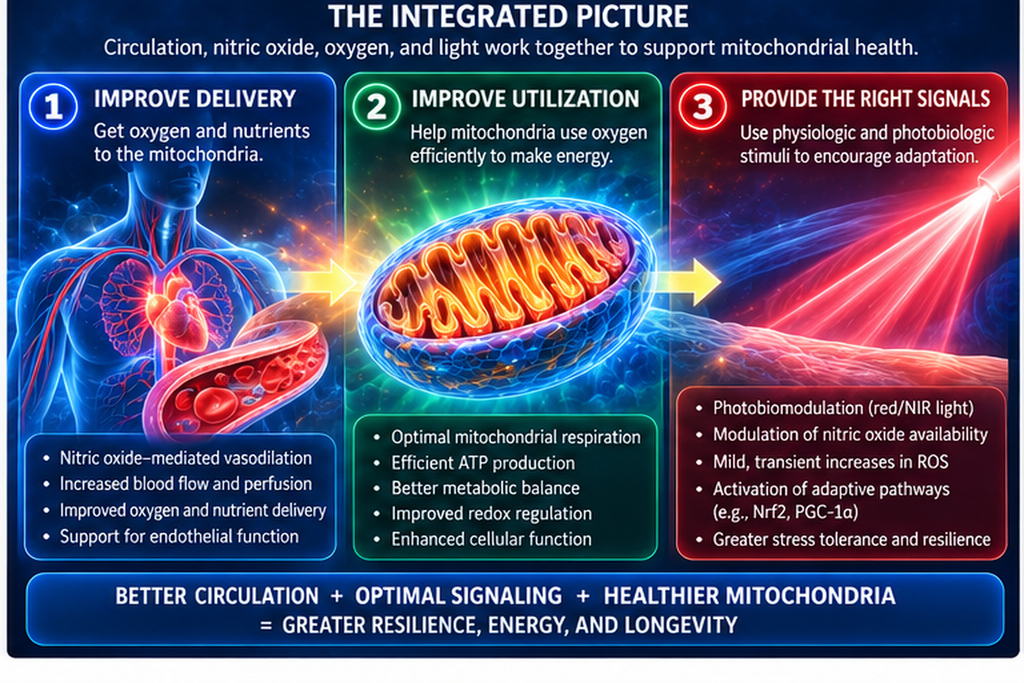
How We Think About Nitric Oxide and Light
We view mitochondrial health as a systems problem rather than simply a question of adding another supplement.
Blood flow affects mitochondrial function. Mitochondria influence redox biology. Nitric oxide regulates both circulation and respiration. Photobiomodulation may influence mitochondrial and nitric oxide signaling. Exercise and other physiologic challenges modify many of the same pathways.
These are not necessarily separate biological stories. They intersect at oxygen delivery, energy production, redox regulation, and cellular signaling.
The goal is not simply to force mitochondria to produce more ATP. It is to create an environment in which cells can receive what they need, use it efficiently, respond to the right signals, and adapt appropriately.
That, in many ways, is the recurring theme of this entire series: mitochondrial resilience depends on the quality of the system surrounding the mitochondrion as much as on the organelle itself.
Next in the Series: Essential Cofactors and Metabolic Support
Mitochondria can have excellent circulation, appropriate signaling, and healthy architecture, but their enzymes still require specific raw materials and cofactors to function normally.
In Part Seven, we will explore the essential cofactors and metabolic supports involved in mitochondrial energy production, including B vitamins, magnesium, iron, copper, CoQ10, taurine, omega-3 fatty acids, carnitine, and ketones.
Because sometimes the mitochondrial engine is intact. The signal is appropriate. The oxygen is available. But the machinery may still be missing something it needs to operate.
Dr. Joseph Purita