
The Mitochondrion, Part 2:
Inside the Mitochondrial Engine
How Cells Turn Fuel into Usable Energy
A Series on Cellular Energy and Healthy Aging
Every heartbeat, every muscle contraction, every nerve impulse, and virtually every process of cellular repair requires energy. Mitochondria produce much of that usable energy as ATP, or adenosine triphosphate. In Part One of this series, we explored redox balance—the relationship between mitochondrial energy production, reactive oxygen species, antioxidant defenses, and the cell’s ability to respond to stress. Now we move deeper inside the mitochondrion to look at the machinery that actually produces that energy.
Mitochondria take energy stored in carbohydrates, fats, and other nutrients and convert much of it into ATP. But food does not simply enter a mitochondrion and become energy. Between those two points lies an extraordinarily sophisticated system involving fuel processing, electron transfer, electrical gradients, specialized membranes, and one of biology’s most remarkable molecular machines: ATP synthase.
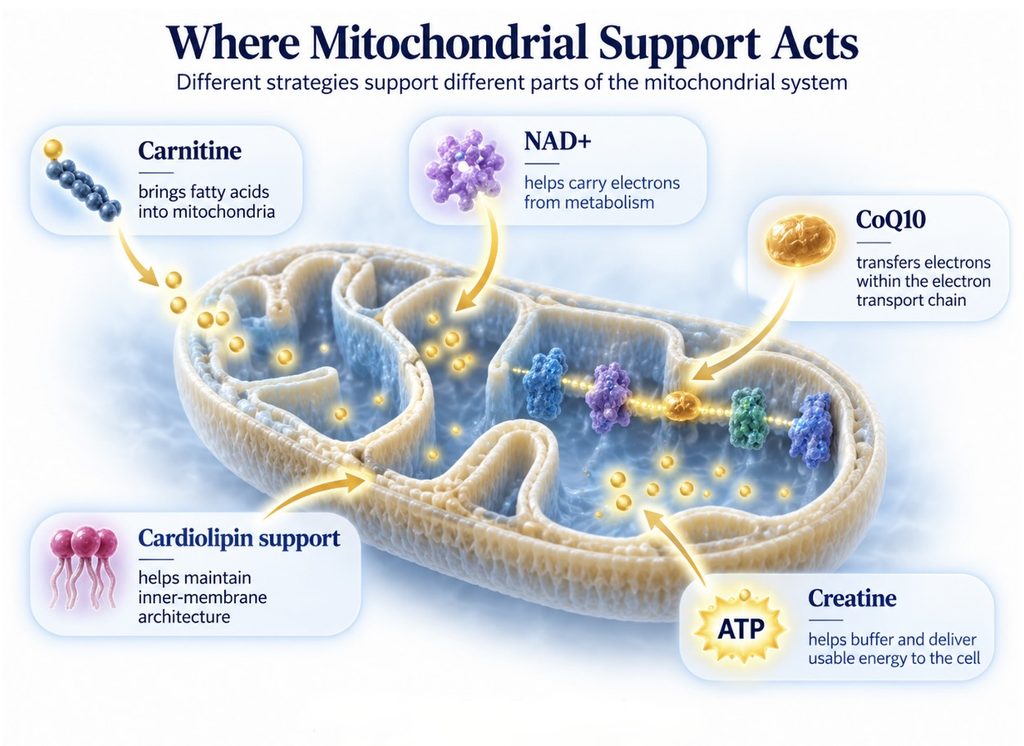
Understanding this system changes the way we think about “mitochondrial support.” NAD+, CoQ10, carnitine, creatine, cardiolipin, and oxygen can all influence mitochondrial energetics, but they do not do the same thing. Each acts at a different point within the mitochondrial engine.
First, the Cell Has to Extract Energy from Fuel
The process begins with the foods we eat and the energy we store. Carbohydrates break down into glucose and ultimately pyruvate. Fatty acids can be transported into mitochondria and broken down through beta-oxidation, while amino acids can enter mitochondrial metabolism at several different points. Much of this metabolism ultimately feeds into the TCA cycle, also known as the Krebs or citric acid cycle.
One of the TCA cycle’s most important jobs is to capture energy from food in the form of high-energy electrons. Those electrons are loaded onto carrier molecules—primarily NADH and FADH2. Think of them as charged delivery vehicles that carry energetic electrons from nutrient breakdown to the next stage of energy production: the electron transport chain.
The Electron Transport Chain: Capturing Energy From Electrons
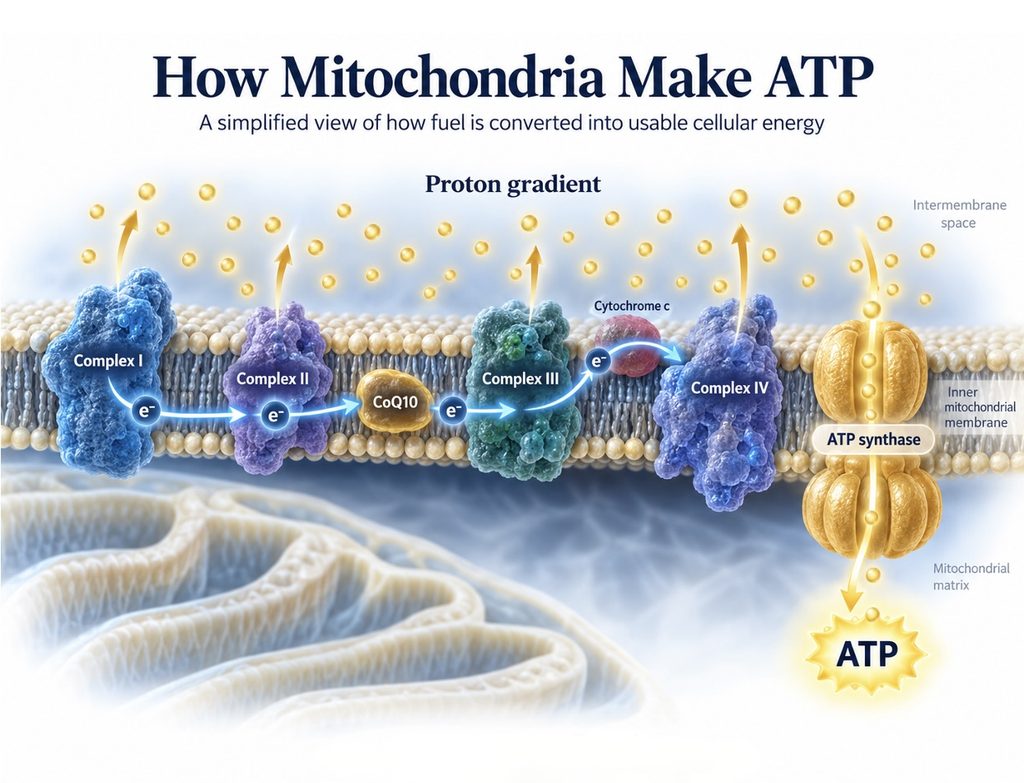
Embedded within the inner mitochondrial membrane is a series of protein complexes collectively known as the electron transport chain, or ETC. NADH delivers electrons primarily to Complex I, while FADH2-associated electrons can enter through Complex II. From there, electrons move through an organized sequence toward Complex IV.
Two smaller carriers help connect the system. Coenzyme Q10, or CoQ10, carries electrons from Complexes I and II toward Complex III, while cytochrome c carries them onward to Complex IV. At the end of the chain, oxygen accepts the electrons and ultimately helps form water.
This is one reason oxygen is so fundamental to life. We normally think of oxygen in terms of breathing and blood oxygen levels, but deep inside the cell it performs another essential function: oxygen allows the mitochondrial electron transport chain to keep moving. The real importance of this electron flow, however, is what the mitochondrion does with the energy it releases.
The Mitochondrion Builds a Tiny Biological Battery
As electrons move through the respiratory chain, Complexes I, III, and IV use some of the energy to pump hydrogen ions (protons) across the inner mitochondrial membrane. Complex II contributes electrons but does not pump protons. This creates both a difference in proton concentration and an electrical charge across the membrane. Together they form an electrochemical gradient, a major component of which is called the mitochondrial membrane potential.
An easy way to picture this is to think of the mitochondrion as a tiny biological battery. The electron transport chain charges the battery. ATP synthase taps that stored energy. Energy originally contained in food has now been converted into energetic electrons and then into electrical and chemical energy stored across a membrane. But the cell still has to convert that stored energy into something it can actually use.
ATP Synthase: A Microscopic Molecular Turbine
ATP synthase, also known as Complex V, does that job. The protons that accumulate on one side of the inner mitochondrial membrane naturally want to flow back. ATP synthase provides a controlled pathway for them to do so.
As protons pass through ATP synthase, portions of the enzyme actually rotate. This mechanical motion allows the enzyme to combine ADP with phosphate to produce ATP. Energy from food has therefore been converted into electron movement, then into a membrane gradient, and finally into usable cellular energy. This entire process is known as oxidative phosphorylation. It is the mitochondrion’s central energy-producing machinery.
Why the Shape of the Mitochondrion Matters
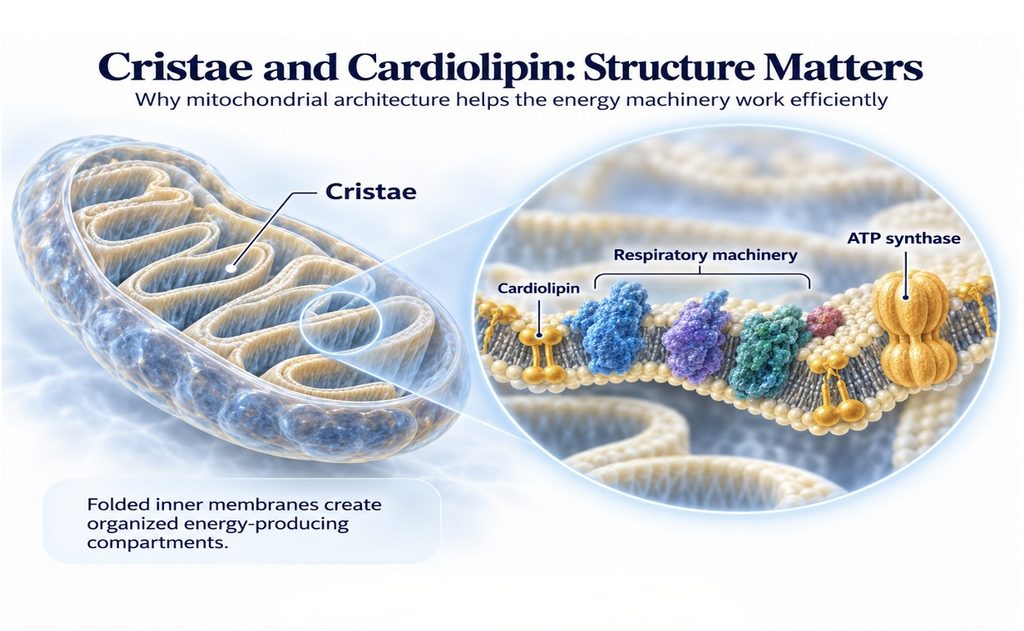
When most people picture a mitochondrion, they imagine a bean-shaped structure with folds inside it. Those folds are called cristae, and they are far more important than they may appear.
Cristae are folds of the inner mitochondrial membrane that greatly increase its surface area. More importantly, they help organize the electron transport chain, ATP synthase, and local proton gradients into highly efficient energy-producing regions. Their shape is not fixed. Cristae can remodel as cellular conditions and energy demands change.
This means mitochondrial performance depends not only on having the right molecules but also on having the right architecture. The machinery must be properly organized. That brings us to one of the least appreciated components of mitochondrial biology: cardiolipin.
Cardiolipin: Part of the Architecture of Energy
Cardiolipin is a specialized phospholipid found predominantly within the inner mitochondrial membrane. It interacts closely with many of the proteins responsible for energy production and helps support the organization and stability of cristae, respiratory-chain proteins, and ATP synthase.
One way to think about cardiolipin is as part of the platform on which the mitochondrial engine is assembled. If the respiratory complexes are the machinery, cardiolipin helps create the structural environment that allows that machinery to operate efficiently.
Changes in cardiolipin composition, organization, or oxidation can therefore affect mitochondrial structure and energy production. This leads to an important concept: supporting mitochondrial energy production may sometimes require supporting the architecture in which that energy is produced.
CoQ10: More Than an Antioxidant
CoQ10 is frequently described as an antioxidant, but that description misses its most fundamental mitochondrial function. CoQ10 is part of the electron transport system itself.
It moves within the inner mitochondrial membrane, accepting electrons from Complexes I and II and transferring them toward Complex III. Its reduced form, ubiquinol, also participates in antioxidant chemistry. CoQ10 therefore has a dual role: it participates directly in mitochondrial energy metabolism while also influencing redox biology. This distinction matters because reducing oxidative stress is not always as simple as adding more antioxidants. Sometimes better redox balance may come from handling electrons more efficiently in the first place.
NAD+ and NADH: The Electron Currency of Metabolism
Few molecules in longevity medicine have received as much attention as NAD+, yet its importance stems from basic cellular biology rather than anti-aging marketing. NAD+ accepts electrons during metabolic reactions, becoming NADH. NADH then delivers those electrons to Complex I of the electron transport chain. This continuous cycling between NAD+ and NADH is therefore central to how cells extract and transfer energy from nutrients.
NAD+ also participates in cellular signaling, DNA repair, stress responses, and numerous enzyme systems, which helps explain the scientific interest in NAD metabolism and aging. But an important distinction remains: NAD+ is essential to cellular metabolism, but simply increasing NAD+ does not mean it will reverse mitochondrial aging.
Human studies show that NAD+-boosting precursors such as NR and NMN can increase NAD-related biomarkers, but effects on metabolic, functional, vascular, and other healthspan outcomes have been inconsistent. A 2026 systematic review also found no eligible clinical outcome trials of intravenous or intramuscular NAD+ itself for anti-aging or wellness indications.
At PUR-FORM, I therefore think it is more useful to view NAD-related therapies as one potential tool within a larger mitochondrial strategy, rather than as a stand-alone solution.
Carnitine: Getting Fat Into the Mitochondrial Engine
Before long-chain fatty acids can be used efficiently for mitochondrial energy production, they must first enter the mitochondrial matrix. That requires the carnitine shuttle.
Carnitine helps transport long-chain fatty-acid groups across mitochondrial membranes so they can undergo beta-oxidation. This generates molecules that feed directly into mitochondrial energy pathways.
This makes carnitine fundamentally different from CoQ10. Carnitine helps deliver certain fuels to the mitochondrial machinery, while CoQ10 helps move electrons once that machinery is operating. Both can influence mitochondrial energetics, but they act at completely different points in the system.
Creatine: Moving Energy Where It Is Needed
Creatine provides another example of why mitochondrial support cannot be reduced to a single mechanism. Most people associate creatine with muscle and exercise, but its fundamental biological role involves energy buffering and transport. Mitochondria make ATP, but cells often need large amounts of energy very rapidly, sometimes at locations some distance from the mitochondria. The creatine-phosphocreatine system helps solve this problem by temporarily storing high-energy phosphate and then using it to rapidly regenerate ATP near areas of high demand.
This system is particularly important in tissues such as skeletal muscle, heart, and brain. Creatine therefore does not simply make mitochondria produce more energy. It helps cells buffer, transport, and rapidly regenerate usable energy where it is needed.
Can We Target the Mitochondrial Membrane Itself?
Our growing understanding of cardiolipin has also led to a very different therapeutic concept: targeting the inner mitochondrial membrane itself.
One example is elamipretide, a mitochondria-targeted peptide that interacts with cardiolipin. Rather than simply supplying additional fuel or another antioxidant, this strategy focuses on the membrane environment in which mitochondrial energy production occurs. In September 2025, the FDA granted accelerated approval to elamipretide, marketed as Forzinity, to improve muscle strength in adults and pediatric patients with Barth syndrome weighing at least 30 kilograms. Barth syndrome is a rare mitochondrial disorder closely associated with abnormal cardiolipin biology. The approval is specific to Barth syndrome and requires a confirmatory trial; it should not be interpreted as evidence that elamipretide is an established general anti-aging or mitochondrial wellness treatment. What makes this story particularly interesting is the larger biological principle: the architecture of the mitochondrial membrane itself can be a therapeutic target. That represents a very different way of thinking about mitochondrial medicine.
There Is No Single Mitochondrial Bottleneck
Once we look at the entire system, it becomes clear why there cannot be one universal mitochondrial treatment.
A cell may have adequate fuel but poor fatty-acid transport. It may have plenty of NADH but impaired electron transport. It may move electrons normally but have abnormal inner-membrane architecture. It may create an adequate proton gradient but struggle to convert that gradient efficiently into ATP. Or it may produce ATP effectively but struggle to deliver that energy rapidly to areas of high demand. A cell may also have perfectly adequate nutrients but contain too many damaged mitochondria that should have been repaired, recycled, or replaced.
This is why simply adding more of one molecule does not guarantee better mitochondrial function. More NAD+ cannot bypass a severely dysfunctional respiratory chain. More CoQ10 cannot automatically restore damaged cristae. More fuel isn’t necessarily helpful if the machinery that processes it is impaired.
The better question is not: “What is the best mitochondrial supplement?” The more useful question is “Where in the mitochondrial system is the limitation?”
How We Think About Mitochondrial Health
This is the framework I find most useful. Mitochondrial health is not one pathway, one supplement, or one treatment. It is an interconnected system involving fuel delivery, electron movement, oxygen utilization, membrane structure, ATP production, energy transport, redox balance, and mitochondrial quality control.
That is why CoQ10, NAD-related strategies, creatine, carnitine, exercise, nutritional optimization, oxygen delivery, redox conditioning, and other approaches should not simply be placed into one broad category called “mitochondrial support.” They act at different locations, address different biological problems, and are supported by different levels of clinical evidence.
The goal is not simply to give mitochondria more ingredients. It is to understand where the mitochondrial system may be struggling—and then determine which strategies make biological sense for that part of the system. Once we understand how the mitochondrial engine works, we can begin asking an even more important question:
How do our cells maintain that engine over a lifetime?
Next in the Series: Mitochondrial Quality Control
Producing energy is only part of mitochondrial health. Mitochondria are constantly changing. They divide, fuse together, remodel themselves, repair damage, and communicate with the rest of the cell. When a mitochondrion becomes too damaged to function properly, cells have specialized systems designed to identify and remove it.
In Part Three, we will explore mitochondrial quality control, including mitochondrial biogenesis, fusion and fission, mitophagy, and pathways such as PINK1 and Parkin that help determine whether a mitochondrion should be repaired, recycled, or replaced.
Healthy aging may depend not only on how much energy our mitochondria can produce, but also on how well our cells maintain the mitochondrial population that produces it.
Dr. Joseph Purita