We often describe mitochondria as the “powerhouses of the cell,” but that familiar description captures only a small part of what they actually do. Mitochondria produce much of the energy our cells require, but they also play roles in cellular signaling, metabolism, stress responses, quality control, inflammation, repair, and decisions about whether a damaged cell should recover or be removed.
In other words, mitochondria are not simply microscopic batteries. They are dynamic biological sensors. They constantly receive information about nutrients, oxygen availability, energy demand, oxidative stress, inflammation, exercise, temperature, and the overall condition of the cell. They then help determine how that cell should respond.
This is one reason mitochondrial health has become such an important area in longevity and regenerative medicine. It is also why there is no single “mitochondrial treatment.” Mitochondrial function depends on an interconnected network involving energy production, redox balance, mitochondrial quality control, cellular signaling, nitric oxide, metabolic flexibility, nutrient cofactors, and the body’s response to physiologic stress.
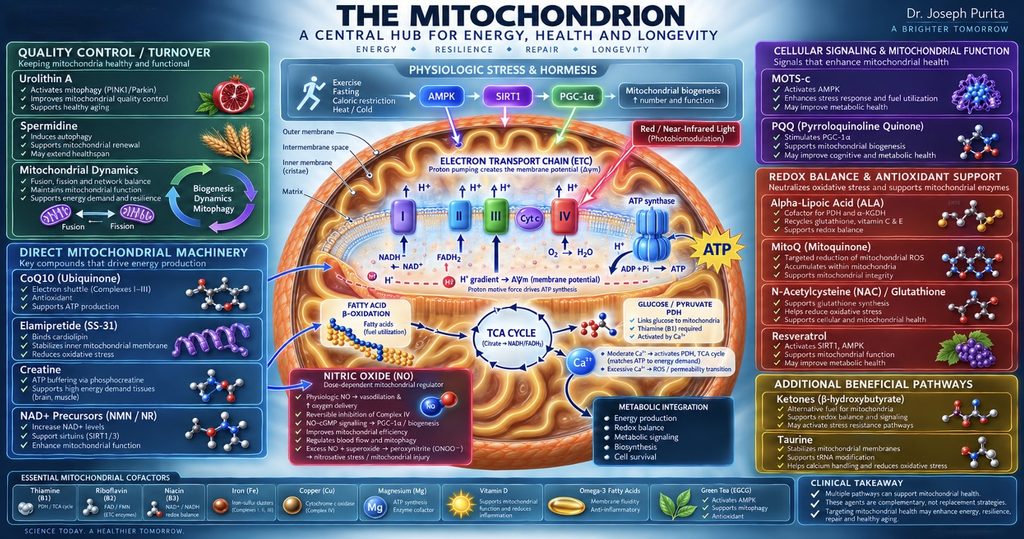
Trying to explain all of these systems in a single article would oversimplify the biology. Instead, in this series, we are going to take the mitochondrion apart piece by piece. We will start with the fundamental biology and then examine the nutrients, lifestyle strategies, compounds, and clinical interventions that may influence those pathways.
The purpose is not to create another supplement list. It is to understand why different approaches may affect mitochondrial function, where they act, and why two interventions described as “mitochondrial support” may actually be doing completely different things.
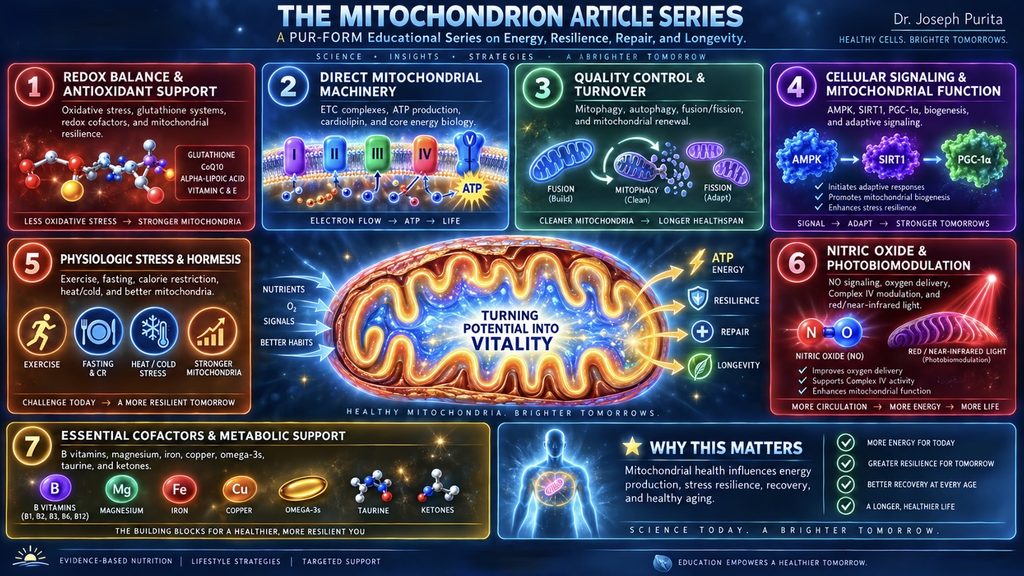
The Mitochondrial Health Series will explore seven interconnected areas of mitochondrial biology, from redox balance and energy production to quality control, signaling, hormesis, nitric oxide, PhotoBioModulation, and essential metabolic cofactors
Part 1: Redox Balance
Why Mitochondria Need More Than Just Antioxidants
For decades, we have been taught a fairly simple story about oxidative stress: free radicals are bad, antioxidants are good, and therefore the more antioxidants we can provide, the better.
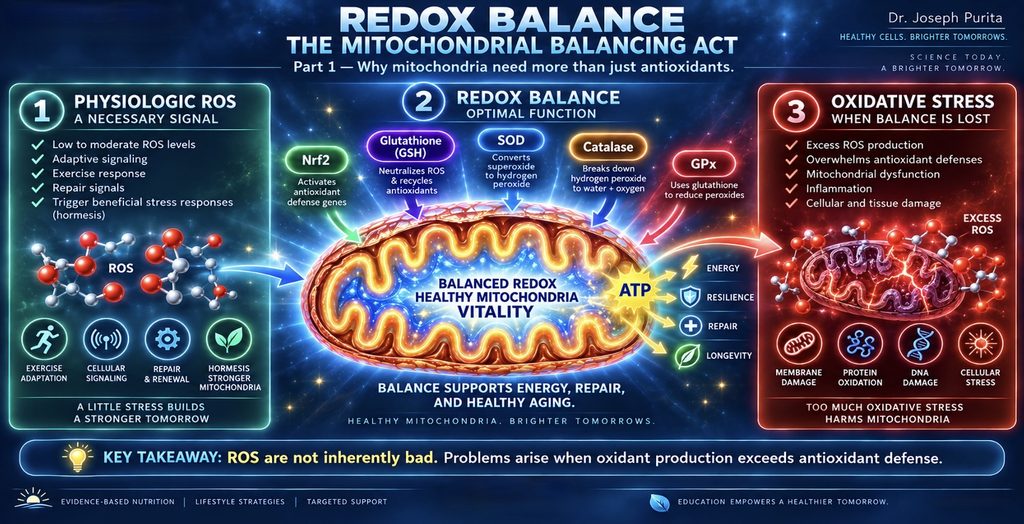
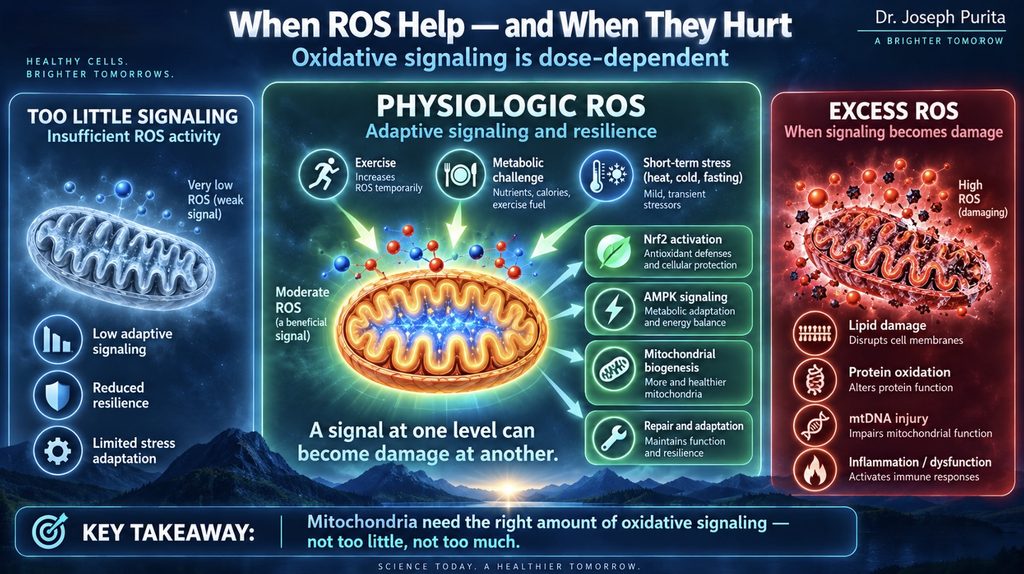
Mitochondrial biology tells us that the real story is considerably more interesting. Our cells actually need a certain amount of oxidative activity. Reactive oxygen species, commonly abbreviated ROS, are not simply toxic waste products waiting to be eliminated. At appropriate levels, they function as signaling molecules that help regulate exercise adaptation, metabolism, immune responses, cellular repair, and mitochondrial biogenesis.
The problem begins when oxidant production exceeds the cell’s ability to control it. That is when useful oxidative signaling can cross over into damaging oxidative stress. The goal, therefore, is not to eliminate oxidation. The goal is redox balance: maintaining the appropriate relationship between oxidant production and the systems that control, use, and clear those oxidants. Mitochondria sit at the center of this balancing act. Mitochondrial respiration produces reactive species, while mitochondrial antioxidant systems—including glutathione-dependent pathways—help maintain the redox environment necessary for normal function.
The Mitochondria Are Producing Energy and Managing Stress at the Same Time
Mitochondria produce energy through an extraordinarily sophisticated process. Electrons derived from carbohydrates, fats, and other fuels enter the electron transport chain, a series of protein complexes embedded in the inner mitochondrial membrane. As those electrons move through the system, protons are pumped across the membrane, creating an electrochemical gradient. ATP synthase then uses that gradient to manufacture ATP, the form of energy cells can readily use.
But this process is not perfectly sealed. During normal mitochondrial respiration, mitochondria can generate reactive oxygen species. In healthy cells, that is not automatically harmful. In fact, mitochondrial ROS participate in redox signaling and can help cells sense metabolic changes and stress. Problems arise when mitochondria are damaged, chronically stressed, metabolically dysfunctional, or unable to manage electron flow efficiently. Oxidant production may rise, while antioxidant defenses and repair mechanisms become inadequate. Excessive ROS can then alter membrane lipids, proteins, and mitochondrial DNA. Mitochondrial damage can, in turn, reduce energy production efficiency and promote additional oxidative stress, creating a potentially self-reinforcing cycle. This is why redox biology is not really about whether oxidation is “good” or “bad.” It is about amount, location, timing, and the cell’s ability to recover.
ROS Are Not the Enemy
Exercise provides one of the easiest ways to understand this concept. When we exercise, energy demand rises dramatically. Mitochondrial activity increases and cells experience a temporary increase in metabolic and oxidative stress. Yet regular exercise is one of the most powerful interventions we know for improving mitochondrial function and metabolic health.
Why would something that temporarily increases oxidative stress ultimately make the system healthier? Because cells use stress as information. A manageable challenge tells the cell that it needs to adapt. In response, signaling pathways can increase antioxidant defenses, improve energy handling, stimulate repair, and promote mitochondrial production and remodeling. This is part of the broader concept of hormesis—a relatively small challenge stimulates an adaptive response that makes the biological system more resilient.
That also means suppressing every oxidative signal is not necessarily desirable. The objective is not a cell that never experiences stress. It is a cell that can recognize stress, respond appropriately, repair itself, and return to equilibrium.
Glutathione: Much More Than a Simple Antioxidant
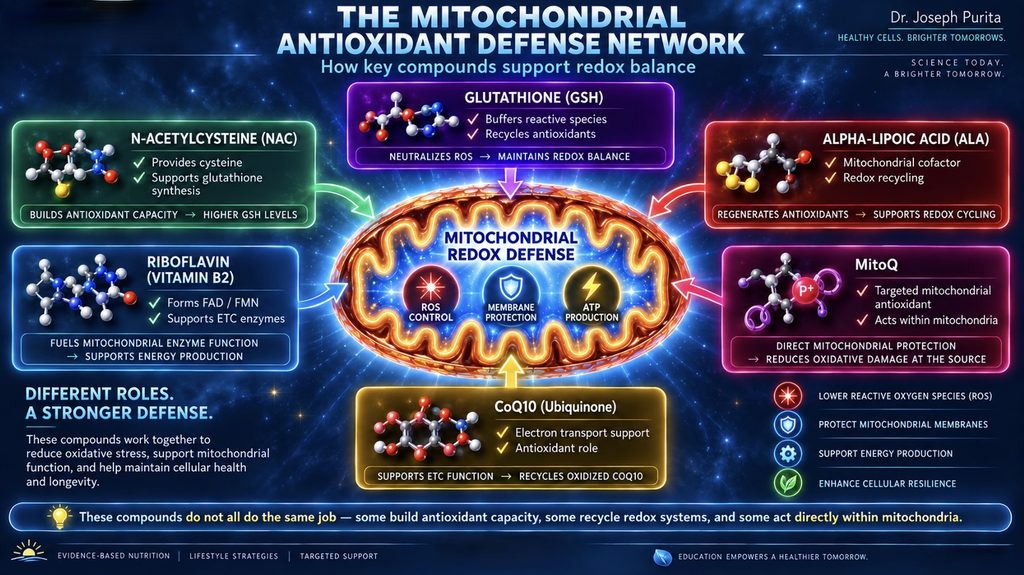
One of the most important components of the body’s redox defense system is glutathione, often abbreviated GSH. It is sometimes called the “master antioxidant,” although that description does not fully capture its biological importance.
Glutathione acts as part of a much larger redox-buffering network. It helps control peroxides and other reactive compounds, supports detoxification reactions, participates in protein redox regulation, and works with enzymes such as glutathione peroxidases. Although glutathione is synthesized in the cytosol, mitochondria maintain an important glutathione pool of their own, where GSH helps defend against respiration-related oxidative stress. The relationship between reduced glutathione and its oxidized form also reflects part of the cell’s redox environment. Glutathione is continually being oxidized and regenerated. The important point is not simply how much glutathione exists, but whether the system can recycle and maintain it.
This is where N-acetylcysteine, or NAC, becomes relevant. NAC provides cysteine, an amino acid that can become rate-limiting for glutathione synthesis. Rather than thinking of NAC simply as a molecule that scavenges free radicals, it may be more useful to think of it as supporting the machinery the body uses to build one of its major endogenous antioxidant systems.
Alpha-Lipoic Acid:
Where Redox Biology Meets Energy Metabolism
Alpha-lipoic acid, or ALA, illustrates just how difficult it is to separate mitochondrial energy production from antioxidant biology. Lipoic acid functions as an essential cofactor for mitochondrial enzyme complexes including pyruvate dehydrogenase and alpha-ketoglutarate dehydrogenase. These systems help move the carbon derived from nutrients into the pathways responsible for cellular energy production.
At the same time, lipoic acid and its reduced form participate in redox chemistry and interact with other antioxidant systems. That dual role makes an important point: the mitochondrion does not have one department responsible for energy and another responsible for redox balance. Electron handling, energy production, antioxidant defense, and metabolic signaling are intimately connected.
Riboflavin and CoQ10:
Sometimes Prevention Begins with Better Electron Handling
Another underappreciated mitochondrial nutrient is riboflavin, or vitamin B2. Riboflavin is required to form FAD and FMN, cofactors used throughout cellular metabolism, including mitochondrial electron-transfer reactions. Supporting the machinery that handles electrons efficiently is fundamentally different from trying to neutralize reactive species after those electrons have already escaped.
CoQ10, or ubiquinone, is another good example. CoQ10 is an integral component of the electron transport chain, carrying electrons from Complexes I and II toward Complex III. Its reduced form, ubiquinol, also participates in antioxidant chemistry. This leads to an important principle in mitochondrial medicine: sometimes the best way to reduce oxidative stress is not simply to add more antioxidants. It is to improve how efficiently the mitochondria handle electrons in the first place.
MitoQ:
Taking Antioxidant Support Directly to the Mitochondria
Scientists have also explored ways of targeting antioxidant activity specifically to mitochondria. One of the best-known compounds in this category is MitoQ. MitoQ combines a ubiquinone-related antioxidant component with a positively charged targeting group designed to promote accumulation within mitochondria. The concept is appealing: if mitochondria can be both a source and a target of oxidative stress, perhaps concentrating an antioxidant within the organelle may be more biologically targeted than simply increasing antioxidant exposure throughout the body.
MitoQ has been studied in many experimental and human contexts, but its clinical significance varies by condition. It is therefore better viewed as an evolving strategy for mitochondria-targeted redox modulation rather than a universal solution. The larger lesson is that glutathione, NAC, alpha-lipoic acid, riboflavin, CoQ10, and MitoQ should not be grouped together simply because they can all influence oxidative biology. They do different jobs in different places.
Nrf2: Turning On the Cell’s Own Defense System
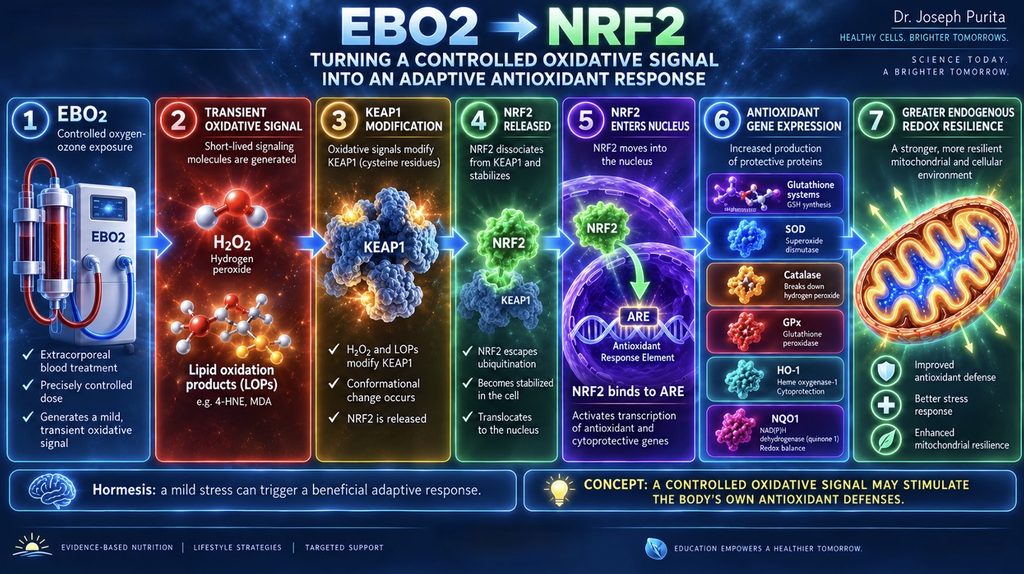
One of the most fascinating pathways in modern redox biology involves a transcription factor called Nrf2, or nuclear factor erythroid 2-related factor 2. Nrf2 is not itself an antioxidant. It is better thought of as a cellular defense coordinator. Under relatively unstressed conditions, Nrf2 is regulated in part by a protein called KEAP1. When cells encounter certain oxidative or electrophilic signals, KEAP1 can be modified. Nrf2 can then become stabilized, accumulate, and enter the nucleus, where it interacts with DNA regions known as antioxidant response elements, or AREs. That can increase expression of a broad range of cytoprotective genes involved in glutathione metabolism, detoxification, redox control, and stress resistance. The KEAP1-Nrf2 pathway is therefore one of the major cellular systems for responding to oxidative and electrophilic challenges. This changes the way we think about antioxidant support. Instead of asking only, “How can we provide another antioxidant?”, we can also ask a more interesting question:
Can we stimulate the body’s own systems for protecting itself?
EBO2: Can an Oxidative Signal Ultimately Strengthen Antioxidant Defenses?
This brings us to an interesting concept involving EBO2, or extracorporeal blood oxygenation and ozonation, one of the technologies used at PUR-FORM.
At first glance, discussing ozone in an article about antioxidant defense may seem contradictory. Ozone is a powerful oxidant. Why would an oxidative therapy have any place in a discussion of redox health? The answer lies in hormesis. During controlled medical ozone exposure, ozone reacts rapidly with components in biological fluids rather than remaining in the circulation as intact ozone. These reactions generate secondary molecules, including hydrogen peroxide and lipid oxidation products, that can act as redox signals. Experimental research shows that this signaling can influence redox-sensitive pathways, including Nrf2.
The conceptual sequence is fascinating. A brief oxidative stimulus creates signaling molecules. Those signals can modify KEAP1. Nrf2 may then stabilize and move into the nucleus, where it helps activate antioxidant and cytoprotective genes. Experimental ozone literature has described Nrf2-related responses involving antioxidant systems such as glutathione-associated pathways, superoxide dismutase, catalase, glutathione peroxidase, heme oxygenase-1, and NQO1. In simplified terms, the message to the cell may be: “Stress has occurred. Strengthen your defenses.” This differs from simply infusing or swallowing an antioxidant. The objective is potentially to stimulate an endogenous adaptive response.
But an important scientific distinction remains. Experimental research on controlled medical ozone exposure, including cell and animal studies, primarily supports the Nrf2 mechanism. Direct human evidence showing how consistently or strongly EBO2 specifically activates Nrf2 is still limited, and ozone protocols differ substantially in concentration, route, frequency, and treatment design. A recent review of medical ozone highlights this gap between plausible mechanisms and consistently validated clinical outcomes. For that reason, I think it is more scientifically accurate to describe EBO2 as a potential redox-conditioning or hormetic strategy rather than simply calling it an antioxidant treatment.
Why the Dose Matters
Hormesis also teaches us something critically important: more is not necessarily better. A manageable physiologic challenge may stimulate adaptation. An excessive challenge can overwhelm the very systems we are trying to strengthen. This principle applies to exercise, heat exposure, fasting, oxidative stress, and potentially medical ozone exposure. That is why discussions about redox medicine become misleading when reduced to simple extremes. “Oxidants are bad” is too simplistic. But so is the idea that because some oxidative stress can trigger adaptive pathways, more oxidative stress must be beneficial. Biology operates within ranges. The desired response is a signal strong enough to provoke adaptation without overwhelming the system’s capacity to recover.
Antioxidant Support Is Bigger Than Antioxidants
Once we understand this, the phrase “antioxidant therapy” begins to seem almost too narrow. Glutathione and NAC can support antioxidant capacity. Alpha-lipoic acid participates in mitochondrial energy metabolism and redox cycling. Riboflavin provides cofactors for electron-transfer reactions. CoQ10 helps the electron transport chain operate while also participating in antioxidant chemistry. MitoQ is an effort to direct redox activity specifically toward mitochondria. Nrf2 represents a completely different approach—activating the cell’s own defense program. And then there are the fundamentals: exercise, sleep, metabolic health, nutrient sufficiency, circulation, oxygen delivery, inflammation control, and removal of damaged mitochondria. All of these can influence the redox environment in which the cell operates. That is why I think of redox balance as a network, not a supplement category.
Why This Matters as We Age
Aging brings changes in mitochondrial function, redox signaling, antioxidant systems, metabolism, inflammation, and mitochondrial quality control. Damaged mitochondria may accumulate, while the ability to respond to physiologic challenges can become less robust. But that does not mean aging is simply the result of “too many free radicals.” The older free-radical theory of aging does not adequately explain the complexity we now see in mitochondrial biology. A more useful concept may be redox resilience: the ability of cells to experience a challenge, generate an appropriate signal, activate protective pathways, repair what needs to be repaired, and return to equilibrium.
That ability may matter more than simply trying to achieve the lowest possible level of oxidative activity. At PUR-FORM, this is one reason we approach mitochondrial health as part of a larger regenerative ecosystem. Supporting mitochondria is not simply about administering CoQ10, glutathione, NAD+, or any single molecule. It means considering the environment in which those mitochondria are functioning—the patient’s metabolic health, nutrient status, circulation, oxygen delivery, inflammatory burden, redox state, quality-control mechanisms, and ability to respond to physiologic stress. Mitochondria do far more than manufacture ATP. They constantly sense their environment and help determine how the cell should respond. And one of the most important signs of mitochondrial health may not be the ability to avoid stress, but the ability to respond to stress, recover from it, and become more resilient because of it.
Next in the Series:
Direct Mitochondrial Machinery
In Part 2, we will move deeper inside the mitochondrion and examine the machinery that actually converts fuel into usable cellular energy. We will explore the electron transport chain, mitochondrial membrane potential, ATP synthase, CoQ10, cardiolipin, NAD+/NADH, creatine, and other compounds that interact directly with mitochondrial energy production.
Before we can intelligently discuss how to improve mitochondrial performance, we first need to understand how this remarkable biological engine works.
Dr. Purita