What membrane lipids may teach us about synaptic health, inflammation, and the regenerative environment
Earlier this year, I wrote about an often-overlooked group of membrane lipids called plasmalogens and why they may merit more attention in brain health, longevity, and regenerative medicine. In my April 2026 PUR-FORM article, Plasmalogens: The Silent Defenders of Brain, Membranes, and Longevity, I discussed their role in maintaining healthy cell membranes and their potential importance in oxidative stress, inflammation, cellular signaling, and healthy aging. That article focused primarily on what plasmalogens are and why their age-related decline may matter. But another question may be even more interesting from the perspective of regenerative medicine: What happens at the synapse when plasmalogens are restored in an aging brain? A synapse is the microscopic communication point between neurons. At the synapse, one neuron releases neurotransmitters that cross a tiny gap and signal the neighboring cell, allowing information to move through the brain. These connections are dynamic; they can strengthen, weaken, form, or disappear, a process known as synaptic plasticity. Because synaptic membranes depend heavily on specialized lipids, changes in membrane composition with aging may impair communication and plasticity. This is one reason plasmalogens are so intriguing: they may help support the membranes that enable neural signaling.
Plasmalogens are specialized phospholipids found throughout the body but are particularly abundant in the brain, nervous system, heart, immune cells, and myelin. Their levels tend to decline with age, and altered plasmalogen metabolism has been associated with several neurodegenerative disorders. Because neuronal communication depends heavily on healthy cellular membranes, researchers have become increasingly interested in whether restoring plasmalogens might influence some of the biological changes that accompany brain aging.
From the Sea to the Aging Brain
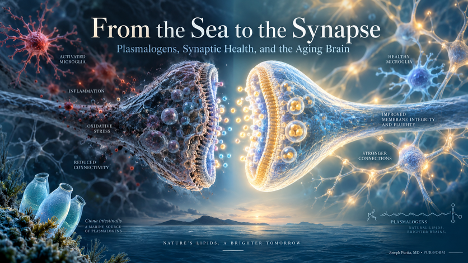
One particularly intriguing study examined plasmalogens from an edible marine organism called an ascidian, commonly called a sea squirt. Researchers administered these plasmalogens to naturally aged mice for two months, then evaluated cognitive performance and brain changes. The treated animals performed better on spatial learning and memory tests, and brain examinations revealed more favorable synaptic characteristics, including increased numbers of synapses and synaptic vesicles, as well as changes in proteins associated with synaptic plasticity and neuronal function. Researchers also observed reduced activation of inflammatory microglia in the hippocampus, a region critical to learning and memory.
Interestingly, the treated animals also developed thicker, glossier, and darker hair during the experiment. While that observation attracted attention, the more important finding was what appeared to be happening within the nervous system: several characteristics of the aging neural environment moved in a healthier direction. These results do not demonstrate that plasmalogens reverse brain aging in humans, but they raise intriguing questions about the relationship between membrane biology, inflammation, and synaptic function.
The synapse may be the most important part of this story. When we discuss brain aging, we often focus on the neuron itself, but a neuron is only useful if it can communicate with other neurons. That communication occurs at the synapse, the microscopic junction where nerve cells exchange information. Learning, memory, processing speed, and higher cognitive functions depend on vast, interconnected networks of these synapses, and with aging and neurodegenerative disease, synaptic integrity and connectivity can progressively deteriorate.
In plasmalogen-treated mice, researchers observed better preservation of hippocampal synapses and more synaptic structures and vesicles than in untreated aged animals. They also found increased levels of synaptophysin, a protein closely associated with synaptic vesicles and synaptic function. To me, this is particularly interesting because plasmalogens were not simply associated with protecting neurons from damage; they appeared to influence some of the biological machinery responsible for communication between neurons. From a regenerative standpoint, that distinction matters. Protecting an individual neuron matters, but preserving or rebuilding the network in which that neuron operates may ultimately matter more.
The Inflammation Connection
The study also highlights the role of microglia, the resident immune cells of the central nervous system. Under normal conditions, microglia continuously survey the brain, clear damaged material, respond to injury and infection, and help maintain the environment surrounding neurons. With aging, however, they can become increasingly activated or “primed,” potentially contributing to persistent low-grade neuroinflammation. This chronic inflammatory state may interfere with neuronal signaling, synaptic maintenance, and the brain’s ability to respond appropriately to injury or regenerative signals.
In the plasmalogen-treated mice, investigators observed less age-associated microglial activation together with reductions in several inflammatory mediators, including IL-1β, IL-6, and TNF-α. This matters because the brain does not repair itself independently of its immune environment. If neurons and synapses remain surrounded by inflammation, oxidative stress, metabolic dysfunction, and impaired cellular signaling, the tissue may be less able to maintain itself or respond optimally to regenerative therapies.
Regeneration Requires the Right Environment
This brings us to a principle that has become increasingly important in how I think about regenerative medicine. For years, much of regenerative medicine has focused on the treatment itself—stem cells, extracellular vesicles and exosomes, growth factors, peptides, and other biologic signals. Those interventions may be important, but we also need to consider the environment receiving the therapy.
I often compare this to planting seeds. You can have extraordinary seeds, but if they are planted into depleted, inflamed, poorly nourished soil, their ability to flourish will be limited. Biology may operate in much the same way. An aging brain may simultaneously be dealing with inflammation, mitochondrial dysfunction, vascular changes, oxidative stress, altered membrane composition, extracellular matrix changes, and loss of synaptic connectivity. Simply delivering another regenerative signal may not correct all of those problems. A more sophisticated strategy may ultimately be to improve the biological terrain while also providing regenerative signals. In that setting, even a powerful regenerative therapy may be limited if the surrounding tissue is not biologically prepared to respond. The goal, therefore, is not simply to deliver a signal, but to restore the conditions that allow that signal to be received, amplified, and translated into repair.
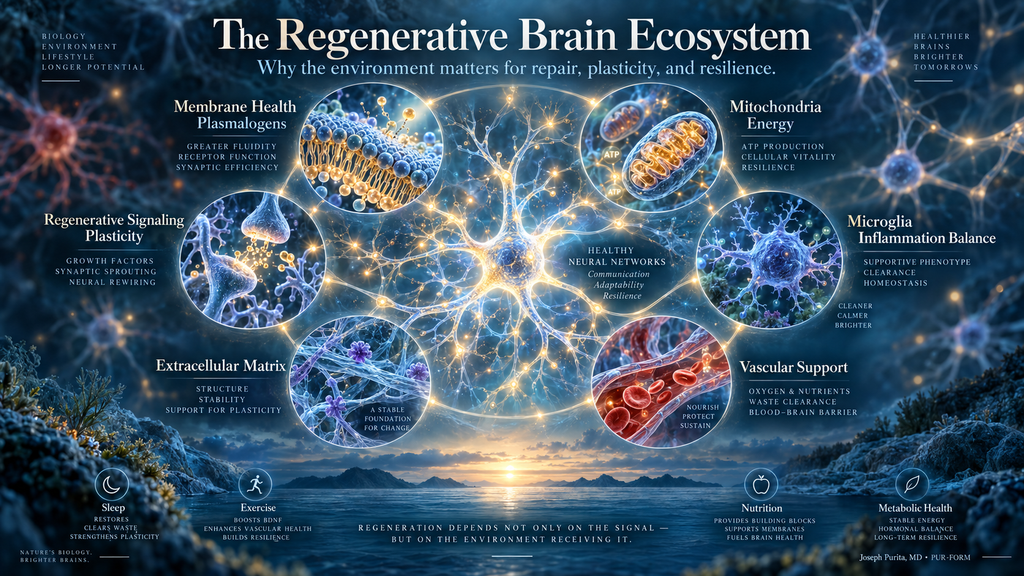
This is why plasmalogens are particularly interesting. Their potential importance extends well beyond taking a supplement to “improve memory.” They sit at an intersection involving membrane integrity, oxidative stress, inflammation, synaptic communication, and neural plasticity. That raises a larger question: Could correcting an age-related membrane deficiency make the brain more receptive to its own repair mechanisms and, eventually, to regenerative therapies?
We do not yet know the answer, but it is a question worth investigating. If membrane integrity improves, inflammatory signaling becomes better regulated, synaptic communication becomes more efficient, and neuronal networks remain more plastic, the biological environment could theoretically respond better to both endogenous repair mechanisms and future regenerative interventions. That represents a very different way of thinking about brain longevity.
The naturally aged mouse study was published in 2022, but subsequent research has continued to examine the relationship among plasmalogens, synaptic function, inflammation, and cognition. A 2025 preclinical study comparing plasmalogens with other common phospholipids, including phosphatidylcholine and phosphatidylserine, again reported improved cognitive performance, along with reduced microglial and astrocyte activation and changes in proteins associated with synaptic integrity. These findings still do not prove the same effects will occur in people, but when different experimental models point to similar pathways involving synaptic integrity, glial inflammation, neuronal communication, and cognition, the biology becomes increasingly compelling.
What About Humans?
This is where we need to remain appropriately cautious. Animal studies are extremely valuable for elucidating mechanisms, but mice are not humans. We still need better clinical research to determine which plasmalogen species are most biologically important, the optimal source and formulation, how effectively orally administered plasmalogens are absorbed and metabolized, and whether supplementation can meaningfully influence plasmalogen biology in the human nervous system. Most importantly, we need to know whether restoring plasmalogens can produce measurable improvements in cognition or neurological function.
For these reasons, plasmalogens should not be described as an established treatment for Alzheimer’s disease, dementia, or brain aging. Nor should the sea-squirt study be interpreted as evidence that eating sea squirts can reverse aging. The science is far more nuanced than that.
The Larger Lesson
To me, the most important lesson from this research may extend beyond plasmalogens. The brain is not simply a collection of neurons that gradually wear out. It is an extraordinarily complex biological ecosystem comprising neurons, microglia, astrocytes, mitochondria, blood vessels, cellular membranes, the extracellular matrix, immune signaling, synapses, nutrients, hormones, and countless molecular messengers. These systems continually influence one another.
That means maintaining brain health will likely never come down to a single pill, supplement, cell therapy, or biological pathway. Successful regeneration requires the right environment. Exercise matters. Sleep matters. Metabolic health matters. Vascular health matters. Mitochondrial function matters. Inflammation matters. Increasingly, we are learning that the lipids that make up our cellular membranes may matter far more than we once thought.
In my April 2026 article, I described plasmalogens as “silent defenders” of our cell membranes. I still think that description is appropriate, but this research suggests another dimension. Perhaps these specialized lipids do more than help protect the aging brain from damage. By supporting membrane structure, influencing inflammatory signaling, and helping maintain the synapses through which neurons communicate, they may also help preserve some of the biological conditions necessary for plasticity and repair.
That possibility makes plasmalogens particularly interesting from a regenerative medicine perspective. We are still early in understanding whether and how this biology can be translated into meaningful human therapies. For now, plasmalogens should be considered a promising area of research rather than a proven anti-aging or neuroregenerative treatment.
The future of regenerative medicine may depend not only on what we give the body, but also on how well we prepare the biological environment to receive the signal. In the aging brain, maintaining healthy cellular membranes may eventually become an important part of that equation. Dr. Purita