I read an interesting article about how low magnesium, the Klotho protein, and regeneration are all related. As we get older, we notice the usual signs of aging: stiff joints, slower recovery, lower energy, and more health issues creeping in. In regenerative medicine, though, we care just as much about your biological age as your chronological age. Biological age reflects how “old” your cells and tissues really are. That is where two under‑appreciated players come in: magnesium and a protein called Klotho.
A recent study examined how your body’s magnesium status relates to Klotho levels, often called an “anti‑aging” protein. Instead of measuring only blood magnesium, the researchers used a magnesium depletion score (MDS). This score estimates your likelihood of being chronically low in magnesium, based on factors such as alcohol intake, certain medications, and kidney function. The higher your score, the more “magnesium‑depleted” you are likely to be.
They found a clear pattern: people with higher MDS (worse magnesium status) had lower blood Klotho levels. In simple terms, the more chronically low you are in magnesium, the lower your levels of this protective protein tend to be. That combination may speed up biological aging and reduce your body’s ability to repair and regenerate.
Klotho is often called an “anti‑aging” or longevity protein, but what does that really mean in practical terms? It was first discovered when scientists noticed that mice lacking the Klotho gene aged extremely quickly, while mice with extra Klotho lived longer and stayed healthier. Since then, Klotho has become one of the most important molecules in the science of aging and tissue protection.
Most Klotho is produced in the kidneys and released into the bloodstream, where it acts as a hormone, sending signals throughout the body. There are two main forms: one attached to cell membranes and one “soluble” form that circulates in blood and other fluids. The soluble form is the one typically measured in studies like the magnesium–Klotho paper we’re discussing.
What does Klotho do in the body?
In simple terms, Klotho helps keep cells younger, calmer, and better organized. It does several key things that matter for aging and regeneration:
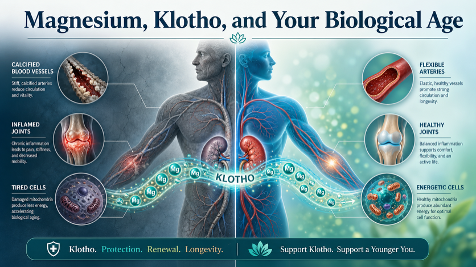
- Helps regulate minerals like calcium and phosphate, preventing them from accumulating in arteries and soft tissues, which can lead to stiffness and calcification.
- Reduces oxidative stress, the kind of “rusting” damage in cells that comes from excess free radicals.
- Calms down overactive signaling pathways (such as insulin/IGF‑1 and Wnt) that, when constantly “turned up,” drive aging, cancer risk, and stem‑cell exhaustion.
- Protects organs, including the brain, kidneys, heart, blood vessels, and even the retina.
Because of this, people with higher Klotho levels tend to have better cardiovascular health, better kidney function, better brain resilience, and a lower burden of age‑related disease in observational studies.
Klotho and the brain, blood vessels, and kidneys
For patients, three Klotho effects are especially relevant:
Brain: Higher Klotho levels are associated with better memory and cognitive function. In animal and primate studies, administering Klotho has been shown to improve learning and brain resilience with age.
Blood vessels: Klotho helps protect against vascular calcification and stiffening, which are major problems in aging, high blood pressure, and chronic kidney disease.
Kidneys: The kidneys are both a major source and a major target of Klotho. When kidney function declines, Klotho levels usually drop, and that drop itself accelerates further damage and systemic aging.
This is one reason the magnesium–Klotho study is so important: it sits right at the crossroads of kidney function, mineral balance, and whole‑body aging biology.
Magnesium, Klotho, and biological age
Magnesium is involved in hundreds of reactions in the body, but one of its most important jobs is helping your mitochondria—the tiny “power plants” in your cells—make energy. When magnesium is low, these power plants struggle. They produce more harmful byproducts called reactive oxygen species (ROS), which damage cells and accelerate aging.
Klotho, on the other hand, helps protect mitochondria and reduce this oxidative stress. When both magnesium and Klotho are low, your cells get hit from both sides: less protection and more damage.
This is especially important in older adults. As we age, many people quietly drift into magnesium deficiency. Diet changes, reduced absorption, and common medications all contribute. Low magnesium is linked with classic markers of aging, such as shorter telomeres (the “caps” on our chromosomes that naturally wear down over time) and higher levels of inflammatory chemicals like IL‑6 and TNF‑α. These same inflammatory signals are involved in arthritis, heart disease, diabetes, and many other age‑related conditions.
Interestingly, Klotho also helps regulate these processes. So two people of the same age on paper can have very different regenerative potential depending on where they sit on this magnesium–Klotho spectrum.
The magnesium depletion score used in the study pulls together four major factors that push magnesium down:
- Alcohol intake
- Diuretic use (water pills)
- Proton pump inhibitor (PPI) use for heartburn and reflux
- Kidney function
These are not rare issues. Many people in midlife and beyond use PPIs, blood pressure medicines, or have some degree of reduced kidney function. The kidneys are also a major source of Klotho and play a key role in magnesium balance. If kidney function is not optimal, both magnesium handling and Klotho production can be affected.
Instead of excluding people with kidney issues, the study built kidney function into the magnesium depletion score, making it more realistic for the types of patients we actually see in practice.
Klotho as a “readout” of biological age
You can think of Klotho as a kind of built‑in “biological age gauge.” When Klotho is high, cells are better protected against oxidative stress and inflammation, energy production works more smoothly, and tissues are more capable of repair. When Klotho is low, the opposite happens: more damage, more calcification, more chronic inflammation, and faster cellular aging.
The magnesium depletion–Klotho link adds another layer: if someone is chronically low in magnesium because of diet, alcohol, PPIs, diuretics, or reduced kidney function, they are more likely to have lower Klotho and thus an “older‑acting” biology, even if they are not very old on paper.
How this connects to regenerative medicine
Regenerative therapies such as stem cell treatments, platelet‑rich plasma (PRP), and exosome therapies aim to help the body repair and renew itself. But these treatments do not work in a vacuum. They interact with your internal “terrain”: your inflammation levels, your mitochondrial health, your circulation, and the state of your stem cells.
If that terrain is hostile, marked by high inflammation, high oxidative stress, and tired, senescent stem cells, even the best regenerative procedure will have a harder time delivering strong, lasting results.
Low magnesium and low Klotho create exactly that kind of hostile terrain. They promote oxidative stress, chronic low‑grade inflammation (sometimes called “inflammaging”), and stem‑cell fatigue. That means your tissues may not respond as well or hold on to the benefits as long when you undergo regenerative treatments.
In contrast, when magnesium status is optimized and Klotho levels are healthier, mitochondria work better, inflammation is calmer, and stem cells are more resilient and responsive.
This is why paying attention to the “magnesium–Klotho axis” is not just an academic idea; it has very practical implications. By identifying and correcting magnesium depletion, especially when it is driven by alcohol use, PPIs, diuretics, or impaired kidney function, we may be able to nudge Klotho levels upward and shift the body into a more youthful, repair‑friendly state. In everyday language, we improve the soil so the seeds of regenerative therapy can grow.
In a regenerative practice, this work is part of preparing the body for regeneration, not an optional extra. Assessing magnesium status, reviewing medications that deplete magnesium, encouraging smart lifestyle changes, and using targeted supplementation when appropriate can all support healthier Klotho activity. The goal is to lower biological age at the cellular level, reduce silent inflammation, and provide your stem cells and any regenerative therapy you choose with the best possible environment to succeed.
Magnesium and Klotho may not be as well‑known as some vitamins or hormones you hear about on TV, but together they tell us a lot about how fast your body is really aging and how ready it is to heal. Taking them seriously is another step toward making regenerative medicine safer, smarter, and more effective in the long term.
In our clinic, we design personalized programs that support the magnesium–Klotho axis, optimize your internal terrain, and then layer in advanced regenerative treatments when the timing is right.
If you would like to find out whether this approach is right for you, consider scheduling a consultation to review your health history, current medications, and goals. It is never too early and rarely too late to start shifting your biology in a more regenerative direction. Below is the reference for the actual article. Dr. Phttps://www.frontiersin.org/journals/nutrition/articles/10.3389/fnut.2025.1518268/full