I recently read an interesting article and posted a review on LinkedIn. Most of us notice that cuts, sprains, and muscle strains heal more slowly in our 60s and 70s than in our 20s. It’s easy to assume this is just “wear and tear” or that our bodies are simply breaking down. But new UCLA research suggests something more interesting is happening: our stem cells may be trading speed for survival.
What the UCLA Study Found
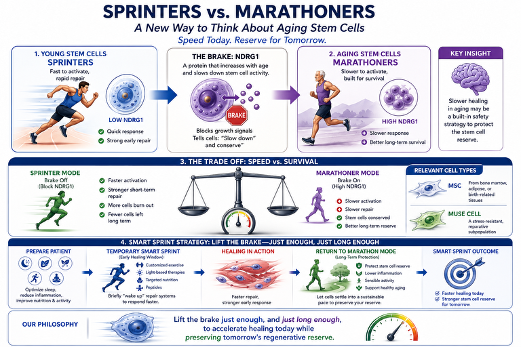
Inside your muscles are specialized repair cells called muscle stem cells (often called satellite cells). When you’re young and injured, these cells wake up quickly, multiply, and help rebuild damaged tissue. Think of them as sprinters: fast off the starting line, built for quick bursts of effort.
In the new study, researchers found that in older animals, these same stem cells behave differently. They discovered a protein inside cells (called NDRG1) that accumulates with age. In young cells, levels are low. In older cells, this protein can be several times higher. When NDRG1 rises, it acts as a brake on a growth pathway that normally tells cells, “Go, divide, repair.”
When scientists blocked this protein in older mice—roughly equivalent to a 75-year-old human—the stem cells suddenly behaved like young ones again. They woke up faster, divided more quickly, and repaired muscle more effectively, at least in the short term.
The Trade‑Off: Faster Today, Fewer Cells Tomorrow
There was a catch. Without this “brake,” more of the old stem cells burned out and died over time, especially when the muscles were repeatedly injured. In other words, they sprinted hard but couldn’t keep it up. The tissue initially healed faster, but in the long run there were fewer stem cells left to handle future injuries.
The researchers called this a kind of “cellular survivorship bias.” Over the years, the stem cells that survive in an aging body tend to be the ones that can withstand stress and remain alive, even if they respond more slowly. The cells that are too aggressive or too fragile quietly disappear. What you end up with is a population of “marathoners”: slower off the start, but better at staying in the race over time.
This challenges a common assumption about aging. Slower healing might not be pure failure or damage. It may be a built-in safety strategy, your body’s way of protecting its stem cell reserve so it doesn’t run out completely.
Why This Matters for Regenerative Medicine
This idea has significant implications for regenerative medicine, including therapies using mesenchymal stem cells (MSCs), MUSE cells, and related products.
Many rejuvenation strategies focus on “turning back the clock” on cells: pushing them to act younger, divide faster, and repair more aggressively. That can be helpful, but if we simply slam on the accelerator by turning off the brakes that aging cells use to protect themselves, we may achieve short-term gains at the cost of long-term stem cell survival.
In practical terms, that means:
- If we push cells too hard, we may get a strong early response but quietly deplete the stem cell pool.
- If we never push them at all, healing stays slow and incomplete.
This work reminds us that there is no free lunch at the cellular level. Any attempt to make an old cell act young needs to be balanced against the risk of burning it out. The goal is not just fast repair today, but also a healthy reserve of stem cells for tomorrow.
How This Connects to MSCs and MUSE Cells
In regenerative medicine, we often work with cell types such as:
- Mesenchymal stromal/stem cells (MSCs) from bone marrow, adipose tissue, or birth‑related tissues
- MUSE cells, a special stress-resistant, reparative subpopulation found in many of these tissues
These cells can behave like sprinters or marathoners depending on how they are programmed, how they’re prepared in the lab, and what kind of environment they encounter in the body. If we artificially “lift the brakes” too far—for example, by strongly activating growth pathways—we might make them more powerful in the short term but shorten their useful lifespan. If we never lift the brakes, they may survive but remain underperforming.
That’s why this study is so important: it highlights a specific “switch” (a survival–performance trade‑off) that we can potentially modulate. It suggests a future where:
- We briefly help cells act like sprinters right after an injury or procedure
- Then allow them to return to a safer, energy‑saving marathon pace once the critical repair phase has passed
The same principle applies whether we are supporting your own internal stem cells or delivering cells from an outside source.
What We Do in Our Clinic
In our clinic, we aim to help your stem cells act more like “smart sprinters” than tired joggers. That means giving them a short burst of extra help when your body needs to heal, without pushing them so hard that they burn out over time. Around the time of an injury or treatment, we use carefully timed tools such as customized exercise plans, light-based therapies, targeted nutrition, and specific peptides to briefly “wake up” your repair systems so they respond faster. Peptides are short chains of amino acids that act as targeted signals; we use them to gently guide healing, support healthy inflammation control, and improve how your tissues respond to injury, rather than simply “forcing” cells to grow.
After that early healing window, we shift the focus back to protecting your long‑term stem cell health with better sleep, lower inflammation, and sensible activity, so your cells can keep working for you for years, not just weeks. When we use stem cell–based treatments (such as MSC or MUSE‑type therapies), we also prepare both you and the cells in advance—improving your overall health, using carefully selected peptides, and “pre‑tuning” the cells in the lab—so they arrive ready to help, but are not forced to stay in overdrive. In simple terms, our goal is to lift the brake just enough, and just long enough, to help you heal faster today without spending the stem cell reserve you’ll need for tomorrow. Dr. Purita