Healthy aging is often discussed in terms of hormones, metabolism, exercise, and nutrition, but beneath these factors lies a more fundamental issue: mitochondrial health. Mitochondria are the structures inside our cells that generate energy, regulate oxidative stress, and help coordinate cellular repair. When they function well, the body is better able to maintain resilience, repair damage, and adapt to the stresses of aging. When they begin to fail, many of the strategies commonly associated with longevity become less effective.
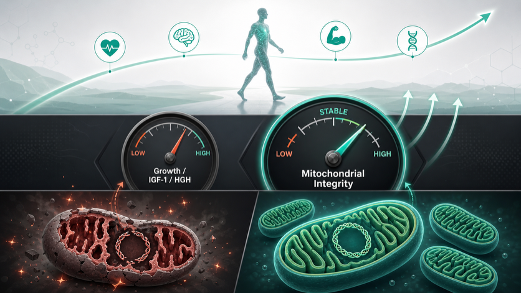
A recent open-access article in Science Advances, titled “The longevity effects of reduced IGF-1 signaling depend on the stability of the mitochondrial genome”, powerfully illustrates this point. The study showed that lowering IGF-1, a key regulator of growth and metabolism, extended lifespan and activated multiple protective aging pathways in normal mice. These pathways included improved DNA repair, stronger protein quality control, healthier telomeres, and a more resilient metabolism. However, when the same IGF-1-lowering intervention was applied to mice with already heavily damaged mitochondrial DNA, lifespan did not increase, and many of these protective programs were blocked or blunted.
The implication is important. Mitochondrial integrity appears to be a foundational layer of aging biology. If mitochondrial DNA is too unstable, the body may not be able to fully activate the repair and resilience programs typically associated with longevity interventions. That does not mean broader longevity strategies are unimportant, but it does mean they work best when the cellular energy system is still functional enough to respond. For patients, this reframes the conversation: effective longevity care is not just about manipulating hormones or calories, but about ensuring that mitochondria can support those changes.
Mitochondria are not passive batteries. They regulate energy production, oxidative stress, inflammation, and key cell-survival decisions. When their structure and genetic stability are preserved, cells are better able to maintain proteostasis, repair DNA, and sustain tissue function over time. When mitochondrial damage accumulates, the cell’s adaptive capacity declines, and many higher-level interventions, including calorie restriction, growth-pathway modulation, or certain pharmacologic strategies, may yield less benefit than expected.
HGH vs. Mitochondria-Centered Longevity
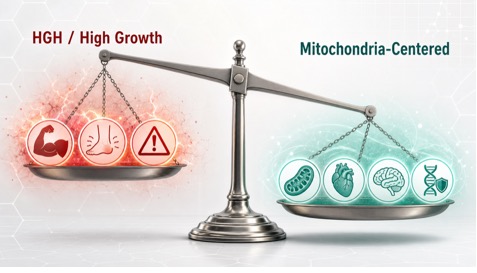
Human growth hormone, or HGH, is often marketed as an antiaging therapy because it can temporarily improve body composition in some individuals. But HGH is not the antiaging solution many people think it is. HGH sits upstream of IGF-1 in the same general axis and promotes growth, anabolism, and higher metabolic turnover. In adults without true growth hormone deficiency, there is no convincing evidence that HGH reverses or meaningfully slows normal aging. Its use carries potential downsides, including fluid retention, joint discomfort, insulin resistance, carpal tunnel symptoms, and possibly an increased long-term risk in susceptible patients.
From a biological standpoint, pushing growth harder is very different from improving the quality of the cellular machinery itself. The Science Advances study suggests that even beneficial changes in growth signaling depend on a reasonably intact mitochondrial system to translate into stronger repair programs and longer life. If mitochondria are already compromised, increasing growth signals may simply increase demand on a system that is struggling to produce energy efficiently. A mitochondria-centered strategy aims to first improve cellular resilience, enabling the body to respond more effectively to other longevity interventions.
A More Rational Longevity Strategy
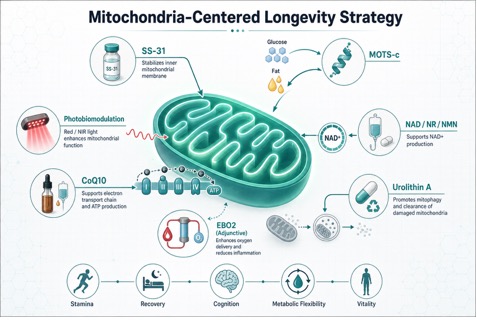
A more thoughtful antiaging strategy focuses on directly supporting mitochondrial health while modulating growth and nutrient-sensing pathways in a physiologic, not excessive, manner. The goal is not merely to create a temporary energy boost but to improve the efficiency, resilience, and stability of the cellular machinery that supports long-term health. When mitochondrial performance improves, patients often notice benefits in stamina, recovery, cognition, metabolic flexibility, and overall vitality.
Mitochondrial health can be supported through several targeted strategies. One example is SS-31, a mitochondria-targeted peptide designed to support the inner mitochondrial membrane, where much of cellular energy production occurs. By helping stabilize this membrane environment, SS-31 may support more efficient energy generation and reduce some downstream stress associated with mitochondrial dysfunction.
Another promising tool is MOTS-c, a mitochondrial-derived peptide involved in metabolic regulation. MOTS-c appears to influence how cells respond to nutrient stress and how efficiently they metabolize glucose and fat for energy. This makes it especially interesting for patients focused on metabolic health, exercise performance, and healthy aging, as it links mitochondrial function to broader energy signaling throughout the body.
IV NAD-based therapy is another important option. NAD is essential for cellular energy production and plays a major role in repair pathways, stress signaling, and mitochondrial maintenance. When NAD levels decline, cells often become less efficient and less resilient. Supporting NAD availability may help improve mitochondrial function, promote recovery, and strengthen repair mechanisms that are especially important as we age. In addition to IV NAD, we recommend oral precursors such as NR or NMN.
Urolithin A is another compelling addition to a mitochondria-centered program. It is best known for supporting mitophagy, the process by which cells identify and recycle damaged mitochondria. This is especially relevant in aging, when worn-out mitochondria can accumulate, reducing the efficiency of the entire system. By helping the body clear dysfunctional mitochondria, urolithin A may support muscle health, endurance, and long-term mitochondrial quality.
CoQ10 also deserves mention, particularly in patients with fatigue, cardiovascular stress, statin exposure, or suspected mitochondrial inefficiency. CoQ10 plays a central role in the electron transport chain, where it helps shuttle electrons for ATP production, and it also functions as an important antioxidant within mitochondrial membranes. Intravenous CoQ10 may be particularly attractive when higher bioavailability is desired or a more direct therapeutic effect is sought.
Photobiomodulation can also fit naturally within this framework. Red and near-infrared light appear to interact with components of the mitochondrial respiratory chain, particularly cytochrome c oxidase, in ways that may enhance ATP production, reduce oxidative stress, and stimulate repair signaling. Clinically, PhotoBioModulation is appealing because it nudges cellular physiology in a favorable direction rather than forcing a blunt hormonal response.
EBO2 is another modality that may play a role in selected patients. By combining extracorporeal blood oxygenation, ozonation, filtration, and light-based treatment, EBO2 is often used in integrative settings to reduce inflammatory burden, improve oxygen delivery, and support systemic recovery. It is best viewed as an adjunctive therapy rather than a primary antiaging intervention and should be presented carefully within the broader context of mitochondrial and metabolic support.
The Missing Piece: Foundations Still Matter
Even the most advanced mitochondrial therapies work best when layered on the basics. Exercise remains one of the most powerful real-world stimuli for mitochondrial biogenesis, metabolic flexibility, and long-term resilience. Resistance training helps preserve muscle mass and insulin sensitivity, while aerobic conditioning improves mitochondrial density and efficiency. Sleep quality, glucose regulation, recovery, and reduction of chronic inflammatory load are equally important because they shape the environment in which mitochondria either thrive or deteriorate.
Nutritional mitochondrial support can further strengthen this foundation. Compounds such as PQQ have been studied for their role in mitochondrial biogenesis, acetyl-L-carnitine supports fatty acid transport into mitochondria, and alpha-lipoic acid contributes to redox balance and mitochondrial enzyme function. These are not substitutes for the core pillars of health, but they can be useful additions within a comprehensive mitochondrial strategy.
Taken together, the emerging science points to a simple yet powerful idea: many longevity interventions depend on mitochondrial health. If the cellular energy system is impaired, the body may not fully benefit from otherwise promising antiaging strategies, and blunt tools like HGH can increase risk without addressing the underlying problem. Supporting mitochondrial health may therefore be one of the most effective ways to strengthen the foundation of healthy aging.
This principle is central to longevity care. Mitochondrial optimization is not viewed as an isolated therapy but as part of a broader effort to enhance cellular performance, resilience, and long-term healthspan. By combining advanced diagnostics with targeted therapies, including SS-31, MOTS-c, NAD support, urolithin A, CoQ10, PhotoBioModulation, and carefully selected adjunctive modalities, the goal is to help patients build a stronger cellular foundation for healthy aging. JP